Why Did Gurgaon Ban S+4?

Summary
What is S+4 Policy in Gurgaon?
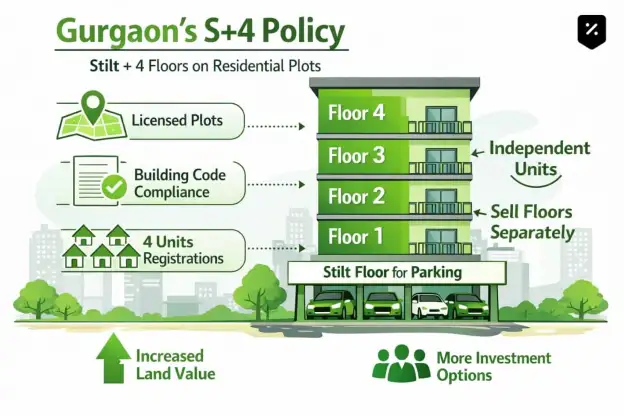
The Haryana government’s decision to permit stilt-plus-four-floor construction in licensed colonies has begun to show visible impact across Gurgaon’s plotted sectors. Under the policy, a single residential plot can now accommodate four independent dwelling units above a stilt level designated for parking and services.
Developers and local brokers say the change has improved the financial viability of plotted developments. “Earlier, returns were limited to a single unit or a duplex structure. Now, the same parcel of land can be split into multiple saleable floors,” said a Gurgaon-based developer operating in Sector 57.
This has led to a steady increase in redevelopment activity, particularly in established sectors where land parcels were underutilised.
Read More: How Much Budget Do You Need To Invest In Gurgaon?
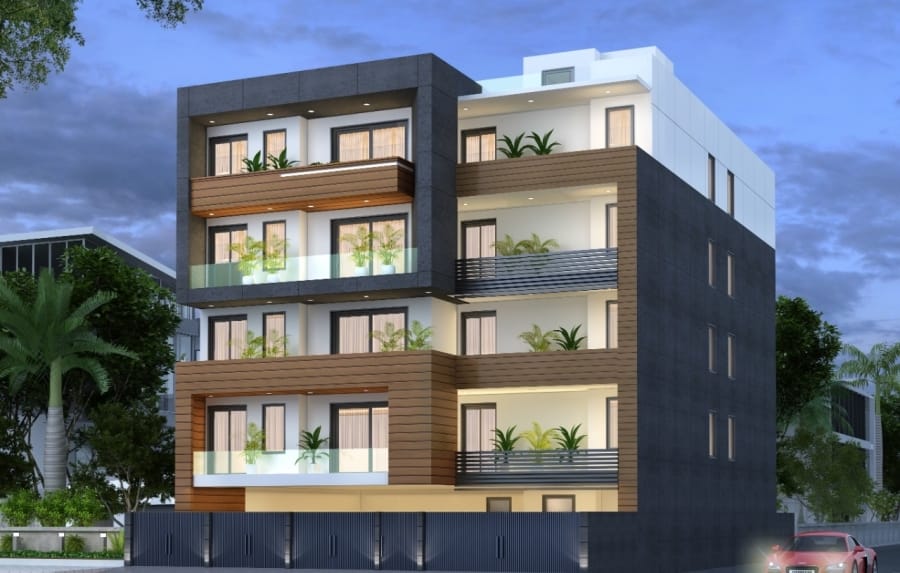
Builder Floors Gain Market Share
With more projects entering the market, builder floors are gaining traction among both end-users and investors. The format offering one residence per floor has found favour among buyers looking for lower density living without moving to villas or farmhouses.
Real estate consultants note that demand is particularly strong in micro-markets such as Golf Course Road, DLF phases, and parts of New Gurgaon. Prices vary widely depending on location and specifications, but the segment has seen consistent absorption over the past few quarters.
At the same time, the supply pipeline has expanded, with several small and mid-sized developers shifting focus from high-rise projects to plotted redevelopment.
Read More: Luxury Apartments vs Builder Floors for Investment
Investor Interest Broadens
The policy has also widened the investor base in Gurgaon’s residential market. By effectively breaking down a plot into multiple units, the entry cost per asset has reduced, making it more accessible compared to traditional plotted investments.
Market participants point out that this has attracted a mix of buyers, including professionals and small investors who were previously limited to apartment investments. The ability to transact floor-wise has also improved liquidity, with shorter holding periods in some cases.
Ticket sizes are still significant, but they are more manageable than buying an entire plot or villa, said a Delhi-based property advisor tracking transactions in Gurgaon.
Changing Nature of Participation
Alongside this shift, there are early signs of change in how such assets are being accessed. In select cases, individuals are exploring structured or shared ownership routes, particularly in higher-value locations where outright acquisition remains capital-intensive.
Platforms such as Estates by Per Annum have begun to position themselves around this space, facilitating participation in residential assets through curated structures starting with just ₹10 Lakhs.
Industry observers say this reflects a broader trend of financial innovation intersecting with traditional real estate formats.
Read More: What is Fractional Real Estate and How does it work
Concerns Around Infrastructure and Compliance
Despite the uptick in activity, concerns remain around infrastructure capacity and regulatory consistency.
Residents in some sectors have flagged issues related to parking congestion and increased load on internal roads. Since multiple families now occupy what was earlier a single dwelling unit, pressure on civic amenities is expected to rise.
There are also variations in construction quality, given the fragmented developer landscape. Legal experts caution that buyers must ensure compliance with approved building plans and clear title documentation, especially in floor-wise transactions.
A Gradual Shift in Urban Form
Urban planners view the S+4 policy as part of a broader transition in Gurgaon’s growth pattern. While high-rise developments continue to dominate large parts of the city, low-rise, plotted redevelopment is emerging as a parallel layer.
The result is a more distributed form of urban density, with independent floors adding to housing supply without the scale of vertical towers.