India's UHNI Population Grew 63% in Five Years, Who are the new Rich?
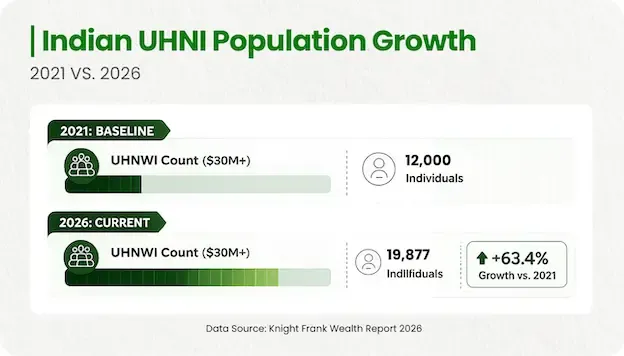
According to data published in Knight Frank's wealth report 2026, India's Ultra High Net Worth Individual population, defined as individuals with a net worth of $30 million (approx ₹250 crore) or more, expanded by 63.4% between 2021 and 2026. The total count rose from approximately 12,000 to 19,877 individuals, placing India as the sixth-largest UHNI base globally and the third-largest hub for billionaires (207 individuals).
This rapid accumulation of ultra-wealth reflects a structural shift in how capital is created in India. The demographic profile of the ultra wealthy is shifting away from legacy industrial conglomerated toward startup founders, technology executives with sizeable ESOP liquidations, private equity investors, and second-generation business leaders executing digital pivots.
In this edition we'll analyse:
- The demographic shift: The transition from legacy manufacturing wealth to tech, venture and capital market liquidity.
- Risk Profiles and Blind Spots: Why new UHNIs exhibit high tolerance for illiquidity alongside severe asset concentration risks.
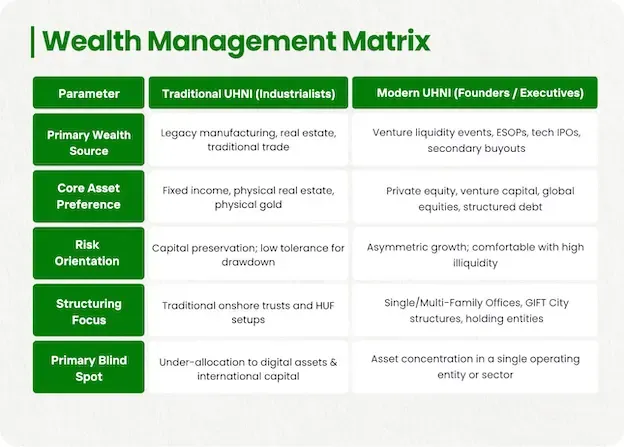
- The wealth management matrix: A comparison of wealth allocation between traditional and modern UHNIs.
- The modern family office architecture: How GIFT City, private credit, and direct co-investments are replacing standard fixed-income products.
Segment 1: Who Are The New Rich?
Historically, Indian ultra-wealth was concentrated in capital-intensive, family-owned manufacturing, real estate, and commodities conglomerates. Capital creation was gradual, compound-driven, and closely tied to physical balance sheets.
The 2021-2026 wealth expansion has introduced three distinct sub-categories of wealth holders:
- Tech founders and early-stage operators: Liquidity events generated via secondary share sales, venture capital buyouts, and domestic initial public offerings (IPOs) have created a class of UHNIs in their 30s and 40s.
- ESOP-Rich Senior Executives: Professional managers at late-stage technology and fintech firms who materialised wealth through structured buy-back programs and market listings.
- Second-Generation Innovators: Heir-operators who inherited traditional family businesses, unlocked trapped value by restructuring operations, and diversified capital into private technology and venture markets.
Segment 2: Risk Profiles and Structural Blind Spots
The wealth creation path of modern entrepreneurs shapes how they evaluate investment risk, creating distinct operational blind spots that traditional private wealth managers often fail to address.

- High Illiquidity Tolerance: Having built wealth through illiquidity equity stakes over 7 to 10 years, modern UHNIs are comfortable locking capital into long-gestation private equity, venture debt, and direct startup investments.
- Concentration Risk: The primary structural vulnerability for first-generation wealth is extreme asset concentration. A founder's net worth is frequently tied up in a single operating business or small basket of tech equities, exposing them to sector-specific drawdowns.
- The operational bias: Modern UHNIs often confuse operational competence in their primary business with investment capability in public markets, leading to overconfident direct trading or unheadged macro bets.
Segment 3: Wealth Management Matrix
Segment 4: Structuring for Next-Gen Capital
To serve this new UHNI demographic, private banking and family offices are moving beyond traditional mutual fund distribution and basic debt products.
- GIFT City and International Diversification: Modern UHNIs demand multi-currency exposure. Wealth managers utilise the Gujarat International Finance Tec-City (GIFT City) framework under the Liberalised Remittance Scheme (LRS) to establish offshore structures, access global private tech markets, and manage currency risk.
- Private Credit and Unstructured Debt: As interest rates fluctuate, modern UHNIs utilise private credit funds and structured venture debt to generate high single-digit, risk-adjusted yields that traditional bank fixed deposits cannot offer.
- Family Office Professionalisation: Rather than relying on informal advisory channels, first-generation wealth holders are increasingly setting up formal single-family offices (SFO) or joining multi-family offices (MFOs) to institutionalise succession planning, tax optimisation, and direct co-investment capabilities.
The Bottom Line
The 63% surge in India's UHNI population signals a permanent evolution in the nation's wealth landscape. As liquid capital shifts from legacy industrial families to tech founders, executives and modern operators, wealth management can no longer rely on standardised preservation-first portfolios.