Will Namma Metro’s Blue Line Impact Property Prices Across Bangalore ?


Summary
1. What Exactly Is the Namma Metro Blue Line
- The Blue Line will run 58.19 km with 29 stations, making it one of Bengaluru’s longest metro corridors
- It connects Central Silk Board → ORR → KR Puram → Hebbal → Airport
- Project cost is estimated at ₹14,788 crore
- Expected to be completed in phases between 2026 and 2027
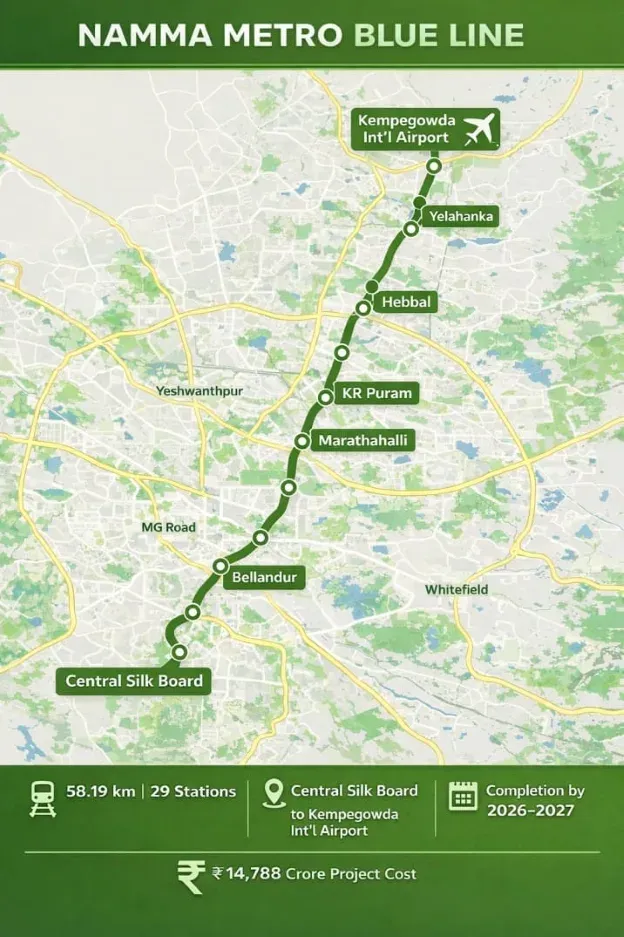
This corridor directly links Bengaluru’s largest employment belt (ORR) with its largest mobility node (airport). Until now, this stretch has been heavily dependent on road transport, with some of the worst traffic congestion in the city.
When commute time drops, distance effectively shrinks, making far-off areas suddenly viable residential options.
2. Why Metro Connectivity Consistently Pushes Property Prices Up
- Properties within 500 metres of metro stations typically see 20–40% higher appreciation
- Rental values increase by 15-20% due to higher tenant demand
Metro-linked areas command a 15-25% premium over non-connected locations
Metro connectivity doesn’t just improve transport, it changes daily life economics:
- Lower commuting costs
- Reduced travel time (often by 30–50%)
- Higher tenant preference
Even if supply increases, demand rises faster in metro-linked zones, keeping prices elevated.
3. Which Areas Are Likely to See the Sharpest Price Growth
High-impact micro-markets along the Blue Line:
- Bellandur & Marathahalli
Already dense IT hubs with high rental demand. Metro access will reduce commute stress, making these areas even more attractive for professionals. - KR Puram
A major interchange connecting multiple corridors. Historically, such nodes see disproportionate price growth. - Hebbal
A premium micro-market with proximity to both the airport and CBD. Metro connectivity strengthens its positioning as a high-value residential zone. - Yelahanka & North Bengaluru
Currently seen as far, but metro access will reposition them as connected suburban hubs.
These are not speculative zones, they already have demand. Metro connectivity amplifies that demand.
4. Outer Ring Road (ORR): The Most Transformative Impact Zone
- ORR hosts India’s largest cluster of IT offices, employing lakhs of professionals
- Currently one of the most congested corridors in Bengaluru
- Metro will significantly cut commute times across this stretch
Today, a 10-12 km commute on ORR can take 60-90 minutes. Metro could reduce this to 20-30 minutes.
Real estate impact:
- Higher rental absorption near stations
- Increased demand for nearby housing
- Potential price acceleration in already premium zones
Key insight:
Unlike new corridors, ORR already has strong economic activity which makes price growth more immediate and sustainable.
5. Airport Corridor
- Areas like Hebbal, Yelahanka, Jakkur are already seeing rising demand
- Metro connectivity will link them directly to central and IT zones
- Expected appreciation range in such corridors: 10-30% over time
Context:
North Bengaluru has long been seen as an investment market rather than an end-user market.
Shift happening now:
- Airport connectivity + metro access = liveable residential zone
- Increased interest in villas, plotted developments, and gated communities.
6. Why Prices May Not Rise Uniformly Everywhere
Not all areas along the Blue Line will see equal gains.
Key deciding factors:
- Distance from the metro station (0-500m benefits most)
- Quality of surrounding infrastructure
- Presence of schools, hospitals, and commercial hubs
- Job density nearby
Metro is a catalyst, not a guarantee.
Areas without supporting infrastructure may see slower appreciation despite connectivity.
7. Rising Prices Are Also Changing How Housing Is Accessed
As metro-led growth pushes up property values, accessing premium residential assets is becoming more challenging in core markets.
This is leading to gradual shifts in how such housing is accessed. Platforms like Estates by Per Annum, which enable co-ownership in Grade A residential properties across Bengaluru, Gurgaon, Noida and Mumbai with entry points starting around ₹10 lakh, are part of this broader transition, emerging alongside traditional ownership in high-value urban markets.
As infrastructure improves, price barriers rise, naturally leading to more structured access formats.
Read More: Wh
Future for Bangalore Real Estate
- Bengaluru housing prices have already seen 49% growth in recent years
- Metro expansion is expected to sustain this momentum
- Strong demand from IT professionals and urban migration will continue
What to expect:
- Gradual but steady price appreciation
- Strong rental markets near metro corridors
- Increased demand for well-connected suburban locations
Conclusion
The Namma Metro Blue Line is set to redefine Bengaluru’s real estate map. By connecting the city’s largest employment corridor to its airport and emerging residential zones, it is creating a new layer of accessibility.
The impact on property prices is already visible in select micro-markets and is likely to deepen as the project nears completion. However, as with most infrastructure-led growth cycles, the biggest gains will be concentrated in areas where connectivity is supported by strong economic and social infrastructure.