Will Heatwaves Kill India's Data Centre Dream?
If you read any institutional equity report or infrastructure brief on India right now, the thesis is identical: India is the next global data centre superpower. The country’s operational capacity recently crossed 1.6 GW. Driven by a massive
AI-capex supercycle and strict local data sovereignty mandates, that figure is projected to skyrocket to over 5 GW by 2030.
The financial model looks pristine on a spreadsheet. But out in the real world, the physical chassis of this entire boom is running headfirst into a brutal, un-modelled reality: 50°C summers, surging wet-bulb temperatures, and an acute freshwater crisis.
While the market models infinite exponential growth for cloud infrastructure, the physical plumbing underneath is quietly flashing red. We are building massive digital fortresses in geographic regions that are literally running out of the two ingredients required to keep them alive: unstressed electricity grids and cheap water.
In this edition, we pull back the curtain on the thermodynamic constraints that the data centre narrative has completely ignored.
In this edition, we’ll analyse:
- Two-Million-Litre Evaporation Loop: The invisible water consumption of a standard 100 MW hyperscale facility.
- Wet-Bulb Failure Point: Why standard evaporative air cooling hits a hard thermodynamic wall at high ambient temperatures.
- 180 GW Cooling Tax: The massive strain placed on the national power grid when data centres are forced to crank up refrigeration mechanisms.
- The Sovereign Arbitrage: How water-stressed metros face a future choice between powering AI applications and providing public utility water.
Segment 1: The Two-Million-Litre Evaporation Loop
There is a common misconception that data centres are green, emission-free warehouses that just run on electricity. In reality, they are industrial water hogs.
To keep high-performance server racks from melting, operators rely heavily on evaporative cooling systems. Water flows through internal heat exchangers, picks up server heat, travels to a cooling tower, and is sprayed into the open air to dissipate that heat through evaporation.
The structural catches? The evaporated water is gone permanently from the local ecosystem. The facility must continuously draw fresh, pristine "make-up water" to prevent mineral scaling on millions of dollars worth of processors.
- The Baseline Math: A typical data centre in India consumes between 1.5 to 2.5 litres of water per kWh of IT load.
- The Hyper-scale Reality: A mid-sized 20 MW facility requires roughly 350 million litres of water annually. For a massive 100 MW hyperscale site, that figure balloons to nearly 2 million litres per single day—roughly equivalent to the daily freshwater requirements of several thousand local households.
Segment 2: Wet-Bulb Temperatures
When ambient summer temperatures hit 45°C to 50°C in primary data centre hubs like Delhi-NCR, Hyderabad, and Mumbai, standard cooling systems experience a dramatic decline in efficiency.
Engineers track a metric called Wet-Bulb Temperature, which factors in both ambient heat and relative atmospheric humidity. When wet-bulb temperatures climb past critical thresholds, air cannot absorb additional evaporated moisture.
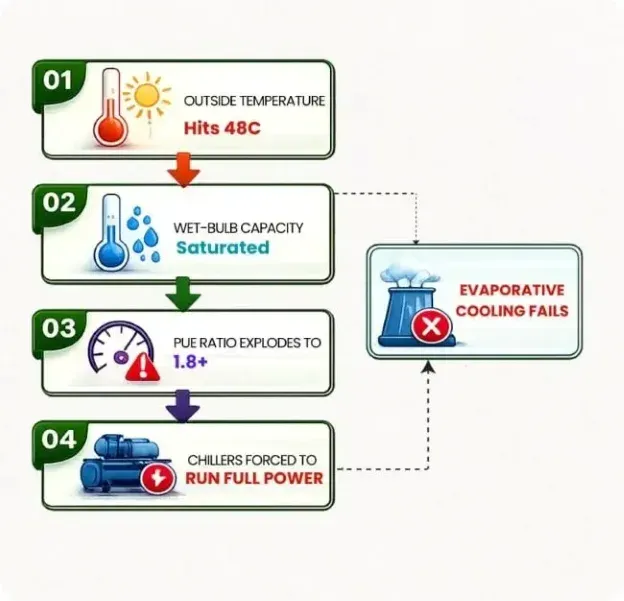
The system can no longer dump heat naturally into the atmosphere. To compensate and prevent emergency server shutdowns, operators must bypass natural evaporative cycles and force industrial chillers to run at full power on pure electricity. This causes a facility's Power Usage Effectiveness (PUE) to swell from a clean baseline of 1.3 to a highly inefficient 1.8+, multiplying energy bills instantly.
Segment 3: The Imminent Conflict: Data vs. Citizens
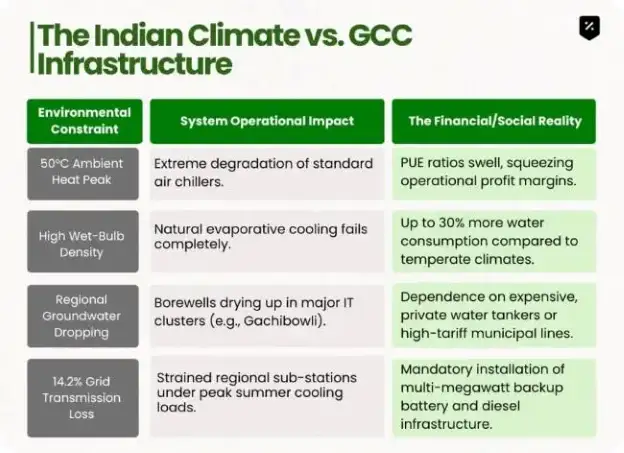
The physical geography of India’s data centre boom reveals a major structural contradiction. An estimated 60% to 80% of India's current and planned data centre capacity sits within regions facing extreme water stress, according to recent sustainability assessments.
Take Mumbai (the anchor market reaching 1 GW of capacity) or Hyderabad (the leading secondary market hub). When groundwater tables in tech corridors like Gachibowli drop significantly in a single quarter due to prolonged summer heatwaves, a highly sensitive sociopolitical conflict begins to brew.
When local municipalities face an choice between rationing water to residential housing societies or maintaining un-interrupted high-pressure lines to cool high-density GPU server farms, the policy calculus will change. Regulatory limits on data centre water access are no longer a matter of "if," but "when".
Segment 4: Advanced Cooling Capex
Traditional air-cooling and water-evaporation designs are reaching their natural limit in tropical climates. If India wants to sustain its AI ambitions without destabilising urban utility networks, the infrastructure layer must undergo a major hardware pivot.
This opens a highly lucrative, multi-billion-dollar niche for alternative tech players:
- Direct-to-Chip & Liquid Immersion Cooling: Completely submerging server blades in dielectric fluid tank environments. This cuts energy consumption by up to 30% and drops PUE ratios close to an incredible 1.1.
- Industrial Closed-Loop Infrastructure: Re-engineering facilities to endlessly recycle condensed moisture, pushing the Water Usage Effectiveness (WUE) to near-zero metrics.
The Bottom Line
The next decade of Indian infrastructure buildout belongs to the entities that can handle the physical consequences of heat.
If you are evaluating tech equities, cloud aggregators, or real estate infrastructure funds, stop looking solely at their pipeline growth projections on paper. Start asking for their thermal management parameters, their closed-loop water metrics, and their proximity to dedicated, resilient power grids.
In a world touching 50°C, the most valuable digital asset isn't code, it’s a sustainable way to keep the silicon cold.