Why Your Wrist is Currently Outperforming Your Nifty 50 Portfolio
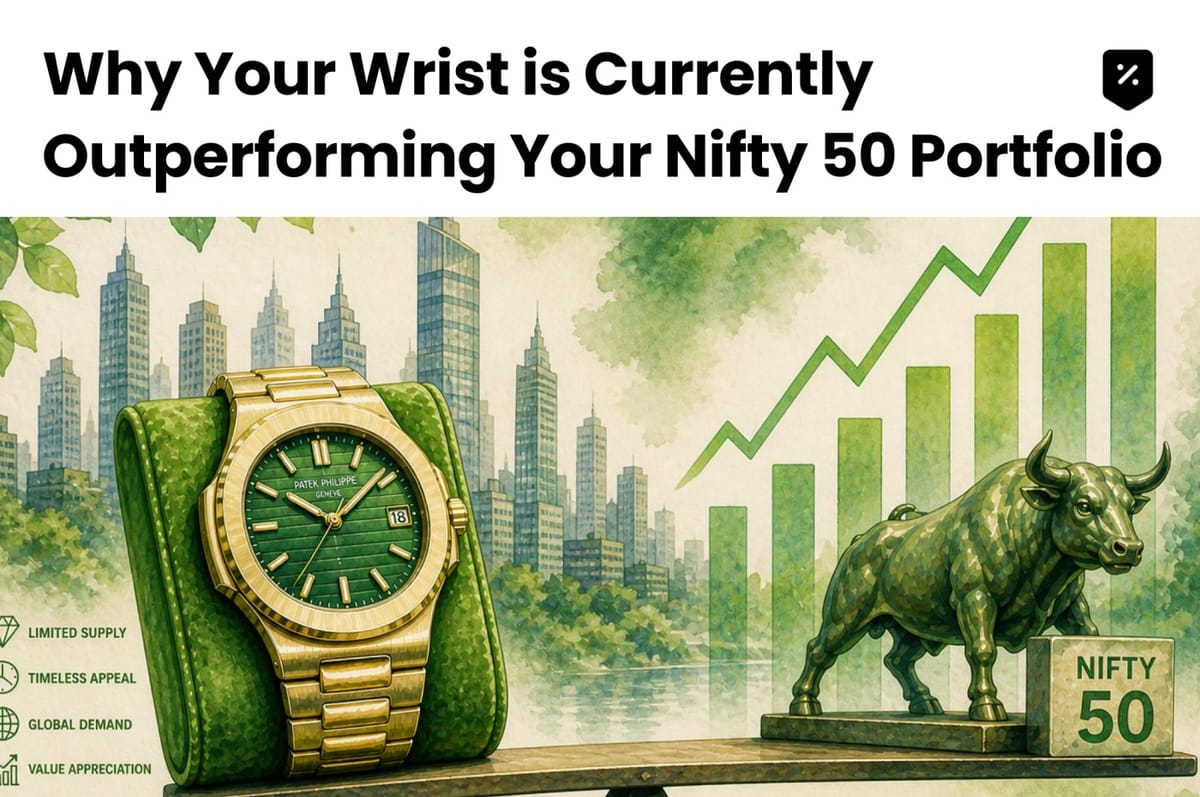
While the captive class of taxpayers has spent 2026 navigating a volatile stock market and high direct taxation, a subset of savvy investors has found alpha in an unlikely place: their wrists. We have moved beyond the era where a luxury watch was a mere vanity purchase. In today’s inflationary environment, a stainless steel Daytona or a Nautilus is no longer just a timepiece, it is a portable, high-liquidity, hard-asset currency.
The secondary market for luxury watches has decoupled from traditional retail. For the first time, "Time" is yielding better returns than equity for many Indian HNIs.
In this edition, we will analyse:
- The Yield Inversion: How the "Holy Trinity" of horology is beating the S&P 500 and Nifty.
- The Currency Hedge: Why luxury watches are the ultimate rupee-devaluation insurance.
- The Scarcity Trap: The retail waitlist economy driving secondary market premiums.
- Asset Allocation: How to treat a timepiece as a 5% satellite asset in a 2026 portfolio.
Segment 1: The Yield Comparison: Watches vs. Wall Street
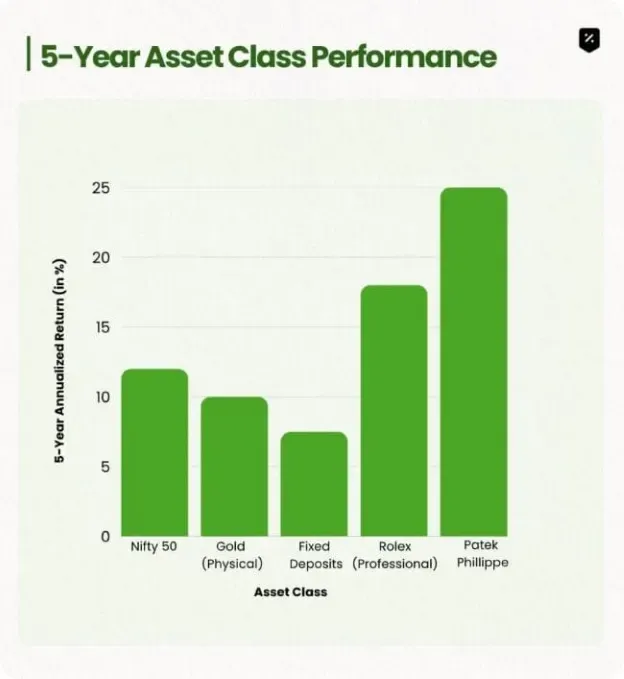
Over the last five years, specifically within the 2024–2026 window, the appreciation of blue-chip watches has outpaced traditional indices. While the stock market is subject to geopolitical shocks and policy shifts, the supply of a discontinued Patek Philippe or a Pepsi GMT-Master II is mathematically capped.
Segment 2: Global Pricing Power
One of the most overlooked aspects of the luxury watch market in India is its status as a dollar-denominated asset.
- Logic: A Rolex has a global price floor. If the Indian Rupee (INR) depreciates against the USD, the value of your watch in INR terms rises automatically, even if the global price remains stagnant.
- Result: For a high-taxpayer in India, owning a high-liquidity collectible is a legal way to maintain global purchasing power without the complexity of foreign exchange accounts.
Segment 3: The Retail Gatekeeping Economy
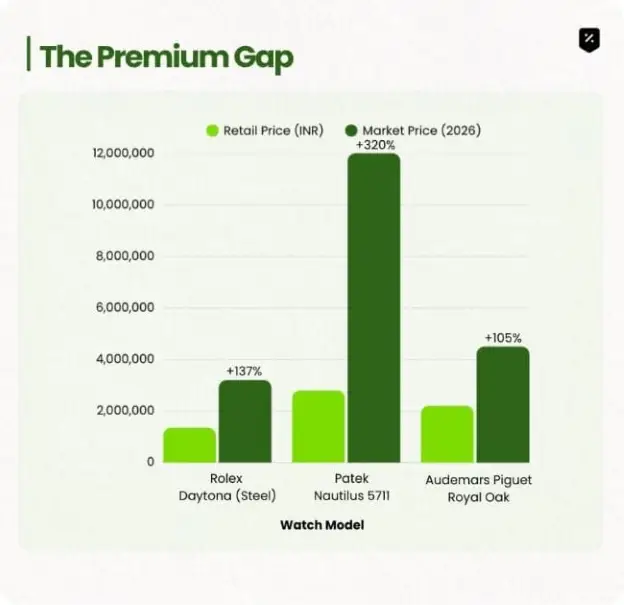
Why does a watch that retails for ₹8 Lakh sell for ₹18 Lakh in the secondary market? Because you cannot buy it at retail.
In 2026, authorized dealers (ADs) have transformed into gatekeepers. This scarcity by design has forced demand into the secondary market, creating a massive premium for unworn or mint condition pieces.
Segment 4: Risk Management
As with any asset class, the "Watch Boom" has risks. The 2026 market is becoming increasingly bifurcated.
- The Hype Trap: Avoid fashion-forward brands that rely on trends. They depreciate as fast as a luxury car.
- Authentication Risk: In the high-stakes secondary market, Super-Clones have become a reality. Certification and Box & Papers are the only way to ensure liquidity.
- Liquidity Lag: Unlike a stock, you cannot sell a watch at the click of a button at a fair price. It requires a specialized dealer or auction house network.