Is India’s Cash Getting an Upgrade?
Despite the mind-boggling dominance of UPI, a quiet truth remains about the Indian economy: cash is still king. Currency in circulation recently hit a record high of ₹42.86 trillion.
But maintaining that massive mountain of paper comes with a brutal price tag.
The Reserve Bank of India (RBI) is actively reconsidering a decade-old vision: replacing traditional cotton-linen paper currency with polymer (plastic) banknotes. The central bank recently deliberated a new pilot project in its board meetings to roll out plastic ₹10 and ₹20 notes.
In this edition, we’ll analyse:
- The ₹6,300 Crore Paper Cut: Why printing traditional currency is bleeding the central bank's balance sheet.
- The Capital Upfront: The true economic cost of mass-producing polymer notes and restructuring India's banking machinery.
- The ATM Calibration Wall: What happens to the country's cash dispensing network when the substrate changes.
- The Pros vs. Cons: The ultimate macro scorecard of switching from cotton to plastic.
Segment 1: Macro Math Driving the Change
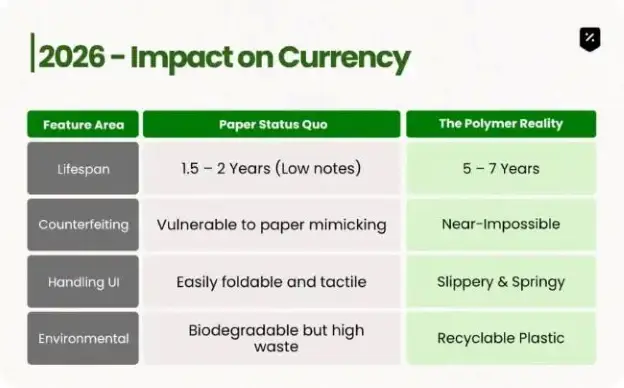
The primary catalyst for the plastic currency push is structural wear and tear. Traditional Indian banknotes are made of cotton-linen paper. They fray, absorb sweat, tear easily, and have an average lifespan of just 1.5 to 2 years in high-circulation denominations.
This rapid deterioration forces the RBI into a constant loop of printing and destruction:
- Production Bill: In FY25, the RBI spent a staggering ₹6,372.8 crore just on printing currency.
- Trash Pile: In the exact same year, the RBI had to withdraw and destroy 23.8 billion soiled banknotes from circulation, with the highest volume coming from heavily handled notes.
Polymer notes, made from bi-axially oriented polypropylene (BOPP), change the lifecycle economics entirely. They last between 2.5 to 4 times longer than paper equivalents.
Segment 2: The Upfront Cost Realities
Transitioning an economy of India’s scale to plastic is an expensive logistical gamble. While polymer reduces long-term reprinting frequencies, the initial investment is highly capital-intensive.
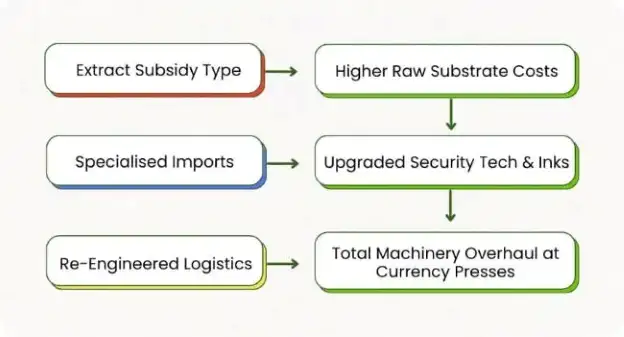
The raw plastic substrate costs significantly more than cotton pulp, and printing requires sophisticated, heavy industrial machinery. The security printing presses in Mysuru and Salboni would require a complete hardware re-engineering to handle plastic sheets, which melt under the traditional intense heat used in high-speed intaglio paper printing.
Segment 3: The ATM Calibration Wall
If this story sounds familiar, it’s because the government approved a field trial of 1 billion plastic ₹10 notes back in 2012 across five diverse climatic cities. The primary reason that experiment stalled? Automated Teller Machines.
Plastic currency reacts completely differently to automated components compared to paper:
- The Static Friction Problem: Polymer notes are incredibly smooth. In highly humid conditions, they generate static electricity, causing notes to stick together inside machine cassettes.
- The Mechanical Calibration Bill: India’s ~2.5 lakh active ATMs utilize mechanical friction rollers calibrated precisely to the thickness and texture of cotton paper.
To transition to plastic, banks must manually recalibrate the physical picking mechanisms, optical note counters, and software sensors of every single ATM in the country. While sources close to current RBI deliberations state that automated banking technology has finally evolved to identify plastic smoothly, the operational rollout across rural networks remains an administrative hurdle.
The Bottom Line
Testing plastic notes on low-value denominations like ₹10 and ₹20 is the ultimate hedge. It targets the highest-friction cash points in the country, the local vendors, bus conductors, and small markets where paper notes turn to shreds in months.
If the RBI can clear the ATM calibration hurdles that broke the 2012 trial, the long-term payoff will save the state thousands of crores in print management. But in an economy where the physical touch of paper is deeply ingrained, the transition will be less about the technology and more about building consumer trust at the grass-roots level.