Capital Appreciation vs Rental Yield
Summary
What is Capital Appreciation?
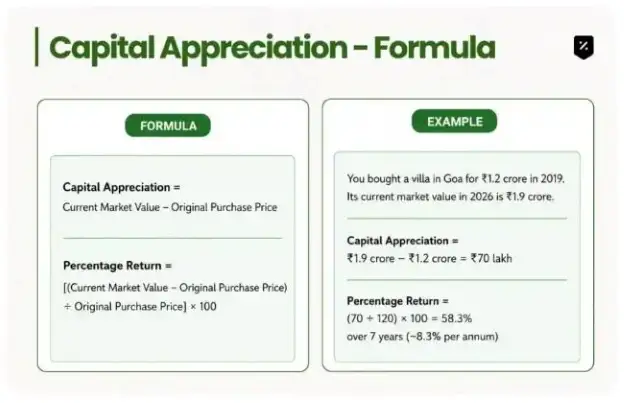
Capital appreciationis simply the increase in the market value of a property over the period that it is held. This is simply the difference between the price at which you bought the property to what the property is worth now. In real terms this gain is realized only after you sell the property.
For instance, if you bought a 2BHK in HITEC City Hyderabad for 60 lakh in 2018, and now in 2026 the property value is worth 1.05 Cr, you have made a gain of 45 lakh on your property, which is a 75% gain over 8 years.
What is Rental Yield?
Rental yield answers the question: how much annual income does my property generate relative to its market value? The rental yield expressed as a percentage gives an investor the benefit to quickly compare property investment with all other investments such asFixed Deposits, Mutual Funds, REITs, etc.
What is rental yield and Rental Yield in India, are important for investors who are looking for a steady passive income as soon as possible as compared to waiting over 8-10 years for an price increase.
Formula for Capital Appreciation
The capital appreciation formula is elegantly simple. It measures the raw rupee gain and can be converted to a percentage return for meaningful comparison.
How to Calculate Rental Yield
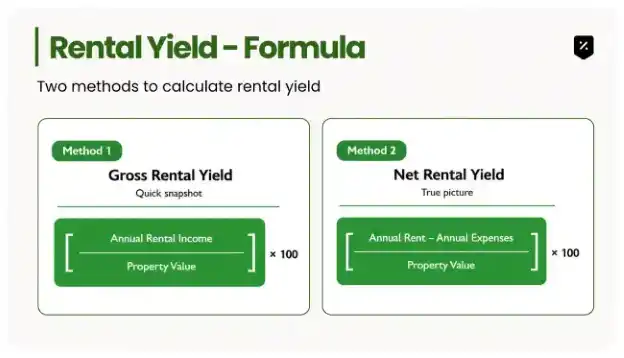
There are two primary methods to determine your rental return. Always calculate both gross yield gives a quick headline number, net yield reveals the true picture after costs.
Typical Rental Yields in India (2025–2026)
Rental yield in India varies significantly by city, micro-market, and asset type. Here are current benchmarks across major real estate markets:
| City / Market | Average Gross Yield | Asset Type | Rating |
|---|---|---|---|
| Bengaluru (Whitefield, Electronic City) | 3.5% – 5.5% | Residential / Co-living | High |
| Hyderabad (HITEC City, Gachibowli) | 3.0% – 4.8% | Residential | High |
| Pune (Hinjewadi, Baner) | 3.0% – 4.5% | Residential | Medium |
| Mumbai (Suburbs: Thane, Navi Mumbai) | 2.5% – 3.8% | Residential | Medium |
| Delhi NCR (Noida, Gurugram) | 2.5% – 4.0% | Residential | Medium |
| Chennai (OMR, Sholinganallur) | 3.0% – 4.5% | Residential | Medium |
| Mumbai (South / Bandra) | 1.5% – 2.5% | Luxury Residential | Low |
| Pan-India Commercial (Grade A Offices) | 6.0% – 9.0% | Commercial | High |
*Figures are indicative estimates based on industry reports for 2025–26. Actual yields vary by specific locality and property condition.
Percentage Return in Capital Appreciation
The india real estate market has seen asymmetric appreciation across cities. Here is how major markets have performed:
| City / Micro-Market | Approx. 5-Year Appreciation | Approx. CAGR | Growth Driver |
|---|---|---|---|
| Hyderabad (Outer Ring Road) | 70% – 100% | 11% – 15% | IT Expansion, Infrastructure |
| Bengaluru (North Bengaluru) | 60% – 90% | 10% – 14% | New Airport Belt, Tech Parks |
| Pune (Hinjewadi Phase III) | 50% – 75% | 9% – 12% | IT Corridor, Metro Projects |
| Mumbai (Thane, Navi Mumbai) | 40% – 65% | 7% – 11% | Infrastructure, Metro Lines |
| Delhi NCR (Dwarka Expressway) | 45% – 70% | 8% – 11% | Completed Expressway Access |
| Goa (North Goa Coastal) | 80% – 120% | 12% – 17% | Tourism, Remote Work Demand |
| Chennai (OMR) | 35% – 55% | 6% – 9% | Steady IT demand |
Key Drivers of Capital Appreciation
The value of a property in India's real estate market does not simply go up on its own. It is driven by a combination of macro-economic and micro-local factors. Understanding these can help you identify undervalued markets before prices surge.
Location & Infrastructure
Properties near developing metro lines, airports, and national highways consistently see the highest value jumps. Early entry near planned infrastructure is the classic wealth-creation strategy in real estate india.
Market Demand & Supply
When demand for homes in a specific corridor outpaces supply as seen in Bengaluru's North Belt prices accelerate quickly. Job creation and population inflows are the key demand drivers.
Inflation & Economy
Real estate has historically acted as an inflation hedge in India. A growing economy with rising wages naturally elevates housing costs over the medium to long term.
Commercial & IT Hub Proximity
Residential properties within 5–8 km of Grade-A office parks and IT SEZs enjoy consistently higher both appreciation and rental demand due to working professional inflow.
RERA & Policy Clarity
Reforms like RERA and GST rationalisation have increased buyer confidence, supporting sustainable demand and reducing speculative distortions in the real estate market.
NRI & Global Demand
Indian diaspora investment, particularly from the US, UAE, and UK, has supported premium segment appreciation especially in Bengaluru, Hyderabad, and Goa luxury markets.
Capital Appreciation vs Rental Yield
| Parameter | Capital Appreciation | Rental Yield |
|---|---|---|
| Nature of Return | Unrealised until sale; long-term wealth creation | Immediate, recurring cash flow |
| Typical Return (India) | 7%–15% CAGR (select markets) | 2%–5% gross annually |
| Liquidity | Low — locked until property is sold | High — monthly income stream |
| Best Suited For | Long-term wealth building (7–15 year horizon) | Retirees, passive income seekers |
| Market Dependency | High — linked to economic cycles and location | Moderate — linked to rental demand |
| Management Effort | Minimal — buy and hold | Active — tenant management required |
| Tax Treatment | LTCG @ 12.5% (after indexation removed per Budget 2024) on gains after 24 months | Added to total income; taxed per applicable slab |
| Best Markets | Emerging corridors: North Bengaluru, ORR Hyderabad, Dwarka Expressway | Established IT belts: Whitefield, HITEC City, Hinjewadi |
Key Considerations Before You Invest
Choose Capital Appreciation If…
- You have a 7–15 year investment horizon
- You do not need immediate monthly income
- You are targeting emerging/underdeveloped corridors
- You want to benefit from India's infrastructure build-out
- You are comfortable with illiquidity and market cycles
- You want to build long-term generational wealth
Choose Rental Yield If…
- You need regular, predictable monthly cash flow
- You are a retiree or building a passive income base
- You prefer established, high-occupancy locations
- You are comparing real estate with FDs or bonds
- You want to reduce vacancy risk with stable tenants
- Commercial or co-living assets interest you
The Smart Investor's Approach: The best real estate investment strategy in India combines both, buy in a location with strong appreciation potential and healthy rental demand. Markets like Bengaluru's Sarjapur Road or Hyderabad's Financial District offer exactly this 4%+ rental yields plus double-digit annual appreciation potential.
Frequently Asked Questions (FAQs)
Q1 - What is a good yield for rental property in India?
A - 3%–4% is average, 4%–6% is good, and above 6% (typically commercial or co-living) is excellent for residential properties in India.
Q2 - What is an ideal rental yield percentage?
A -3%–4.5% net yield is ideal for residential properties. Combined with 8%–12% annual capital appreciation, total returns can reach 11%–16% in strong markets.
Q3 -How do you calculate ROI on property?
A - ROI = [(Capital Gain + Total Rental Income) ÷ Total Investment] × 100. Always include stamp duty, registration, and renovation costs in your total investment figure.
Q4 -What is the difference between capital gains and capital appreciation?
A -Capital appreciation is the unrealised rise in property value while you hold it. Capital gains is the actual profit booked when you sell, that's when it becomes taxable.
Q5 - What is the tax rate on capital appreciation?
A -LTCG (held 24+ months) is taxed at 12.5% without indexation (Budget 2024). STCG (under 24 months) is added to income and taxed at your slab rate.
Read more

India's UHNI Population Grew 63% in Five Years, Who are the new Rich?
According to data published in Knight Frank's wealth report 2026, India's Ultra High Net Worth Individual population, defined as individuals with a net worth of $30 million (approx ₹250 crore) or more, expanded by 63.4% between 2021 and 2026. The total count rose from approximately

Will Real Estate Prices Crash in India? A Data-Backed 2026 Analysis
Every few months, the same headline resurfaces: "Is India's real estate market about to crash?" It's a fair question; prices in cities like Bangalore and Delhi-NCR have risen sharply enough that affordability concerns are genuinely valid, and unsold housing inventory has been climbing for

What is Circle Rate? How It's Different from Market Value?
Frequently Asked Questions (FAQs) Q1 -Is circle rate the same as market value? A -No. Circle rate is the government-fixed minimum value for registration and stamp duty purposes; market value is the actual price a buyer and seller agree upon, which can be higher or lower than the circle rate.

Warehousing & Industrial Real Estate (2026)
Frequently Asked Questions (FAQs) Q1 -Should small investors invest in warehouses in India? A -While the market is booming – H1 2026 registered a 16% spike in leasing and institutional investment up 53% y-o-y - this is one real estate asset Class where returns are closely tied to location, quality of