Buying Your Way into the 10 Year Waiting List


If you want to understand where the truly ridiculous money in India is hiding right now, stop looking at the Nifty luxury index or the Gurgaon penthouse market. Look at the local golf club.
Getting into places like the DLF Golf & Country Club or the Bombay Gymkhana isn't a matter of money anymore. It’s a matter of time. Waiting lists for individual memberships have stretched past 10 to 12 years in most elite clubs.
Because wealthy people aren't exactly known for their patience, a shadowy, highly lucrative secondary market has emerged. Elite club memberships are now being traded under the table, exactly like illiquid, small-cap stocks—complete with massive premiums, corporate shell manoeuvres, and transfer fees that cost more than a luxury sedan.
In this edition, we look at high-society economics and how networking access has officially turned into a literal capital asset class.
In this edition, we’ll analyse:
- The Corporate Loophole: How companies use transferable corporate seats to legally bypass decade-long waiting lists for executives.
- The Premium Matrix: A breakdown of the actual black-market premiums being paid for top-tier access across Delhi-NCR and Mumbai.
- The Transfer Fee Trap: Why clubs are hiking entry penalties to split the profits with secondary sellers.
- The ROI of the Fairway: Why treating a country club membership as an alternative financial asset isn’t as crazy as it sounds.
Segment 1: The Corporate Loophole
Most elite clubs closed their individual membership registries years ago. If you apply normally today, your kids might inherit the slot. To get around this, the ultra-wealthy use the "Corporate Seat" loophole.
When a club opens, it issues a few multi-name corporate memberships to large companies. These seats are legally owned by the company, not the person. If an executive leaves, the company simply swaps the name on the card.
Wealthy individuals are now buying dormant private limited companies simply because those companies hold a legacy corporate seat at a prime club. You aren't buying the business; you are paying ₹50 Lakhs for the corporate registration paper that lets you play 18 holes on Saturday morning.
Segment 2: The Elite Secondary Market
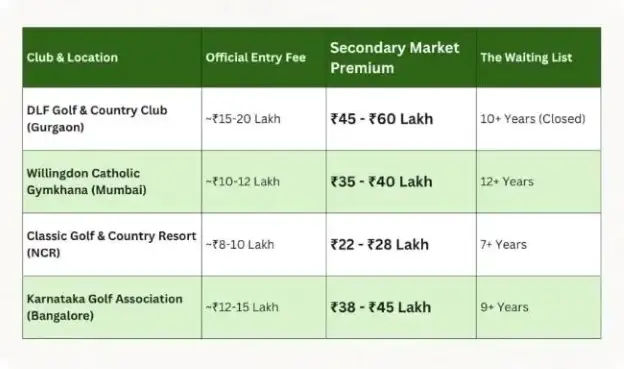
Because these trades happen through private brokers and wealth offices, the prices are rarely public. However, recent transactional data shows the massive gap between official club fees and actual secondary market reality:
Segment 3: The Transfer Fee Trap
The clubs aren't stupid. They know their members are flipping seats for massive profits, so they have engineered their own way to take a cut. Enter the hyper-inflated Transfer Fee.
If you want to sell your corporate slot or transfer it to someone else, the club management will impose a substantial transaction fee.
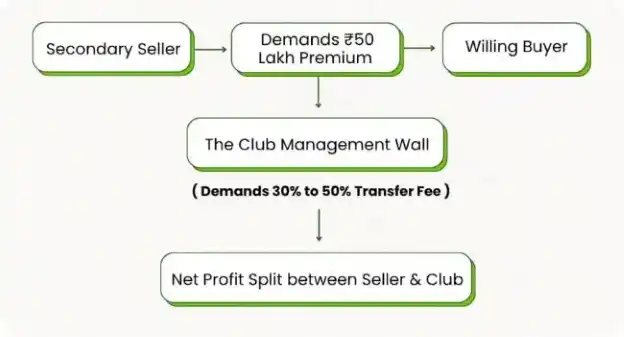
In some elite Delhi-NCR clubs, the transfer fee alone has been hiked to 30% to 50% of the transaction value. It acts exactly like a capital gains tax imposed by a private board. Yet, the buyers keep paying because the value isn't in the grass or the swimming pool, it's in the closed-door network.
Segment 4: Networking as an Alternative Asset
When capital is abundant, but access is strictly rationed, access itself becomes a currency.
Paying a 300% premium for a club membership sounds like peak vanity, but for a certain tier of dealmakers, founders, and fund managers, it’s a calculated business expense. One closed-door conversation in the locker room or on the 14th green can fund the membership premium for the next three lifetimes.
If you are looking for uncorrelated returns in a choppy market, sometimes the best investment isn't on a screen, it's the asset class that gets you into the room where the real decisions are made.