Who Pockets the Profits When Oil Prices Fall?
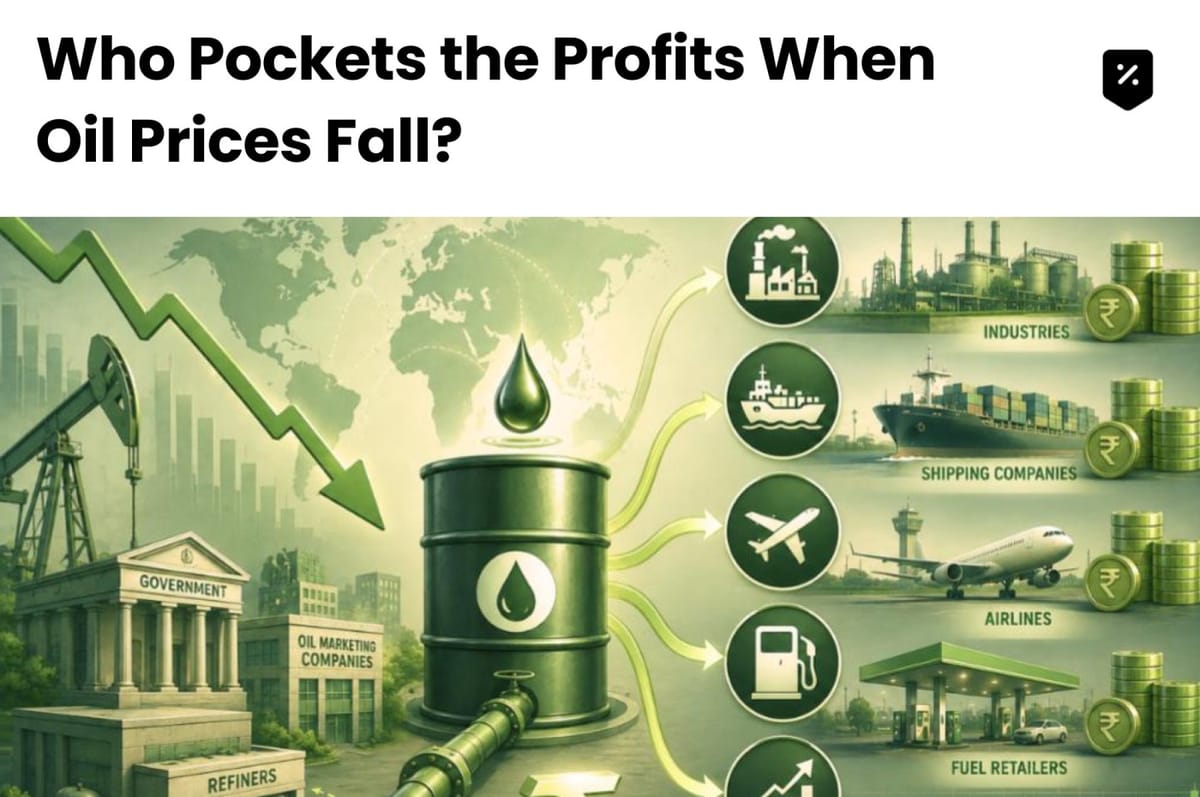
Composite petrol and diesel margins at Indian OMCs have rebounded past pre-West Asia conflict levels as crude falls below $80. A data-backed breakdown of the ₹1.8 lakh crore excise cushion, OMC debt cycles, and frozen pump economics.
The transactional relationship between global crude oil and the price you pay at the local fuel pump has been systematically severed.
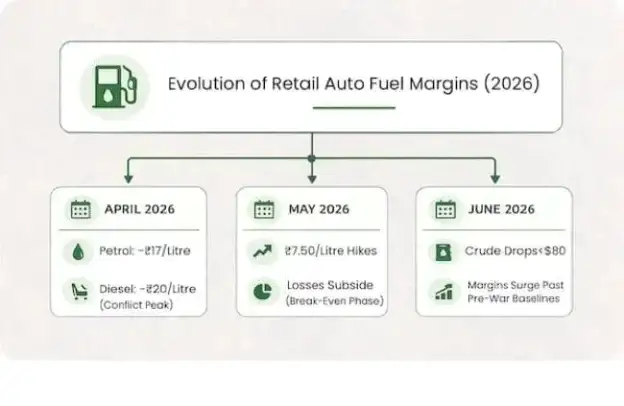
During the height of the recent West Asia conflict, which spiked global energy benchmarks and threatened key shipping corridors like the Strait of Hormuz, India's three state-run Oil Marketing Companies (OMCs), Indian Oil Corporation (IOCL), Bharat Petroleum Corporation (BPCL), and Hindustan Petroleum Corporation (HPCL), were absorbing severe financial punishment. In April 2026, retail marketing margins collapsed to an unsustainable loss of ₹17 per litre for petrol and ₹20 per litre for diesel.
To stem the bleeding, OMCs executed a cumulative retail price hike of ₹7.50 per litre across May.
But since then, the macroeconomic environment has completely reversed. A preliminary diplomatic understanding has pulled Brent crude back down below the $78–$80 per barrel threshold. Yet, a visit to any retail fuel station in Delhi, Mumbai, or Bengaluru reveals that pump prices haven't budged by a single paisa.
According to a comprehensive sector intelligence report released by JP Morgan, composite marketing and refining margins for Indian OMCs have not just recovered; they have quietly climbed above levels seen before the West Asia conflict began.
The fuel-price freeze story has inverted: oil companies are no longer taking hits to protect consumers—they are capturing an extensive margin surplus while retail prices stay locked in place.
In today's edition, we'll analyse:
- Margin Inversion: The exact transition from deep April under-recoveries to June profitability.
- ₹1.8 Lakh Crore Cushion: How a quiet central excise adjustment altered the retail price architecture.
- Balance Sheet Repair: The mountain of short-term debt OMCs must liquidate before prices can drop.
- LPG Structural Drag: The multi-crore under-recovery segment that continues to drain refining profits.
Segment 1: Mechanics of the Margin
To map out where the retail cash is going, look at the dramatic structural swing in daily marketing economics over the last 60 days.
When international crude prices fell, the raw input cost for refiners dropped immediately. In a fully deregulated, dynamic pricing market, this drop would trigger a daily reduction in retail petrol and diesel rates. Instead, the retail price cap stayed fixed.
By holding retail prices completely flat at May's elevated levels while purchasing cheaper raw crude, OMCs have engineered a highly lucrative spread. While standalone marketing margins (the profit made purely at the pump) are still lagging behind long-term historical averages, the combined composite margin—which merges refining profits with retail distribution markups—is delivering strong cash generation for IOCL and BPCL.
Segment 2: ₹1.8 Lakh Crore Excise
This rapid return to profitability was not achieved through market forces alone. The operational survival of the OMCs was heavily subsidized by a massive, unadvertised tax sacrifice by the central government.
Back in March 2026, as oil prices initially threatens to spin out of control, the central government executed a defensive ₹10 per litre cut in excise duties on both petrol and diesel.
- The Corporate Transfer: Rather than passing this ₹10 tax cut down to the end consumer to lower retail inflation, the government allowed the OMCs to keep the retail price steady. This effectively transferred the tax savings directly onto the balance sheets of the oil companies to cushion their massive refining losses.
- The Fiscal Toll: Financial analysts estimate that this structural tax sacrifice has cost the central exchequer an annualized ₹1.8 lakh crore in foregone revenue.
Because the government absorbed the initial macro shock onto its own fiscal deficit ledger, the OMCs are now reaping the full benefits of the crude price correction.
Segment 3: Why Prices Can't Drop Yet
For retail consumers wondering why they aren't seeing a fuel price cut despite crude stabilising below $80, the answer lies in the massive backlog of corporate debt sitting on OMC ledgers.
While OMCs are highly profitable today, they spent the first four months of the year accumulating significant short-term debt to fund under-recoveries. When a company loses ₹20 on every single litre of diesel sold across a country of 1.4 billion people, its cash reserves vanish in weeks.
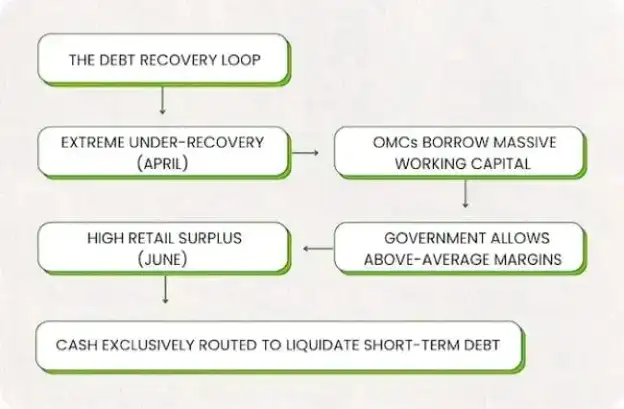
Banking data indicates that short-term borrowings across the three state-run refiners skyrocketed to near-historic highs during the crisis. JP Morgan’s analysis points out that the government is deliberately keeping retail prices high to allow OMCs to retain these above-average margins for a prolonged period. The cash is being funnelled into a dedicated debt-liquidation cycle to repair the companies' credit profiles before any consumer price relief is considered.
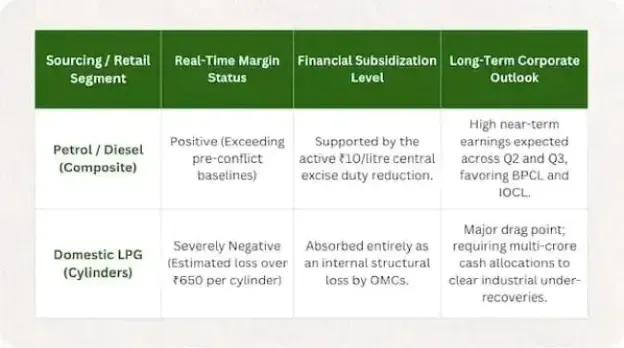
The Current Energy Asset Profitability Ledger
The Bottom Line
The current freeze at the fuel pump is a classic exercise in macro-balancing.
The consumer is paying an elevated artificial premium at the pump, but that premium isn't simply disappearing into thin air. It is being recycled through an institutional pipeline to achieve three specific policy goals: it pays off the massive short-term debt the OMCs accumulated during the West Asia energy shock, it slowly offsets the catastrophic ₹650 per cylinder under-recovery the companies are still taking on domestic LPG sales, and it prepares the ground for the government to eventually restore its missing excise duties once global markets fully stabilize.
For equity allocators, this environment makes state-run oil companies a highly attractive short-term tactical play, with earnings poised to spike significantly in the upcoming quarters. But for the ordinary citizen, it serves as a stark reminder of how the state uses the retail fuel pump as an invisible fiscal shock absorber. You didn't face the full brunt of the price spike when the conflict started—and as a result, you don't get the benefit of the price cut now that it's over.