What Is a Township in Real Estate? A Complete Guide for Investors (2026)
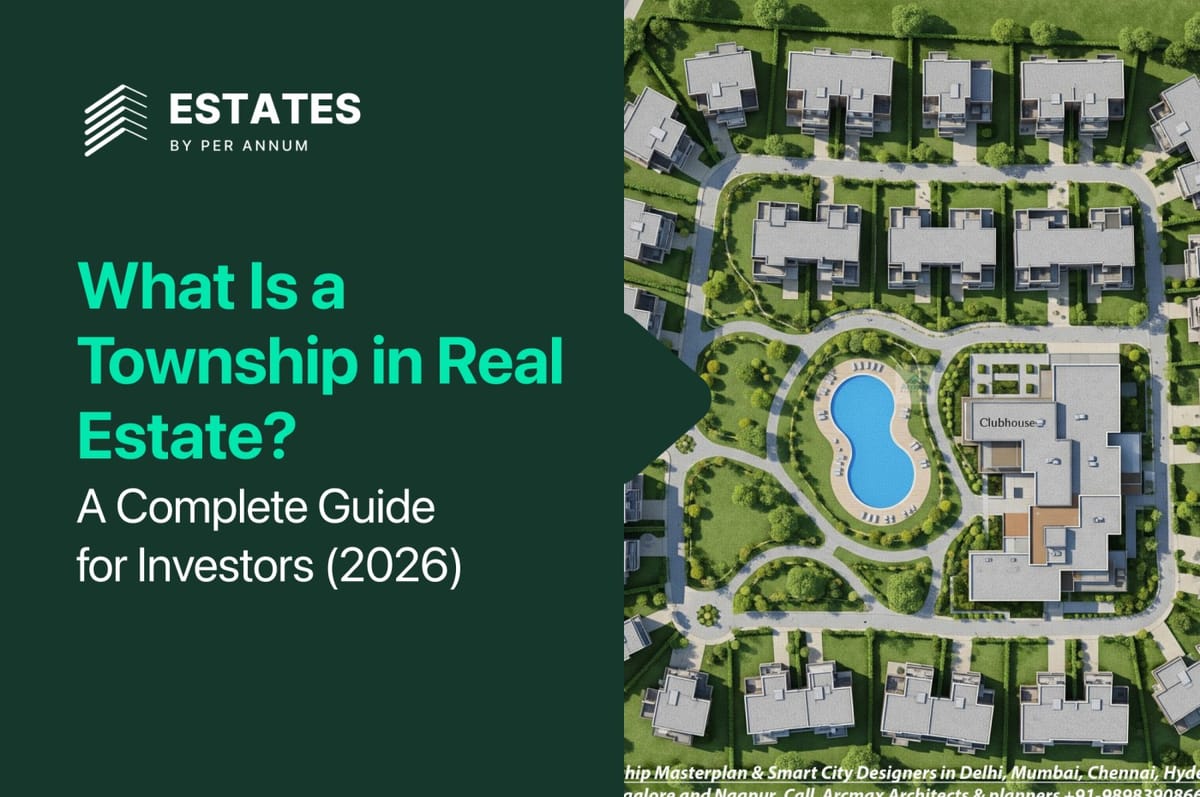
When house-hunting anywhere in India recently, chances are you’ve heard the term ‘township’ at least a million times. Builders use it to label anything from a vast, sprawling 400-acre master-planned community in a city's vicinity to an understated gated enclave with a park and convenience store. This looseness in terminology is precisely why so many homebuyers become bewildered - and why it’s worth doing your homework on what the word truly entails before you hand over a booking cheque.
Here’s a quick guide to everything about townships:
What is a Township?
In real estate, a township is a large, comprehensive, self-sufficient development built on a large tract of land comprising residential housing along with integrated commercial, educational, healthcare, and recreational infrastructure-essentially a “mini-city” rather than a singular building complex. Instead of buying a flat and relying on the city to eventually bring facilities like roads, schools and hospitals close to your residence, in a township, these elements are largely built within the development itself.
A standard township typically has:
- Housing variety: Various types of housing, from apartments, villas and row houses to individual plots and even serviced or senior living accommodations.
- Commercial and retail space: Retail and commercial outlets, like grocery stores, restaurants, cafes and sometimes even offices or IT hubs.
- Social infrastructure: Schools, clinics, community centres and places of worship.
- Recreational activities: clubhouses, swimming pools, gyms, sports courts and green parks.
- Civic infrastructure: including its own internal road network, water and sewage systems, power backup, waste management and security measures, which make it less dependent on municipal authorities.
Most state governments define a minimum area of land (often around 100 acres, but varying by state) for a development to be legally called a township.
Projects with similar features but below that minimum land parcel are often called “integrated communities” or “mini townships,” so it’s essential to look at the actual land area instead of just the marketing jargon.
Township vs. Apartment Project vs. Gated Community: What's the Difference?
| Feature | Standalone Apartment | Gated Community | Integrated Township |
|---|---|---|---|
| Typical land size | Under 5 acres | 5–50 acres | 100+ acres |
| Housing mix | Single format (usually flats) | Flats, sometimes villas | Flats, villas, plots, row houses |
| Commercial space | Rare | Limited retail | Full retail, sometimes office/IT space |
| Schools/healthcare on-site | No | Rarely | Usually yes |
| Dependence on external civic infra | High | Moderate | Low |
| Development timeline | Single phase | Single/few phases | Multi-phase, over 5–15+ years |
| Price point | Lower entry cost | Mid-range | Wide range (affordable to luxury) |
The core distinction is self-sufficiency. A standalone apartment relies on the surrounding neighbourhood for schools, hospitals, and shopping. A township tries to build that ecosystem in-house, which is precisely what drives both its lifestyle appeal and its investment case.
Why Townships Are in High Demand Right Now
- Desire for an all-inclusive lifestyle: People are increasingly seeking comprehensive amenities, security, open green spaces and a sense of community over mere square footage. Townships cater to this trend by design.
- Expansion into Tier-2/Tier-3 cities: Developers are tapping into smaller cities such as Dehradun, Lucknow, Indore, Coimbatore, Nagpur and Mohali to diversify their portfolio and capitalise on rising incomes away from the over-crowded metros.
- Employment hub growth: In major cities like Pune, township demand is directly correlated with the expansion of employment hubs and the introduction of new transport infrastructure like the metro-making them an attractive option for people looking to stay close to work.
- Post-COVID preferences for space and comfort: The continued demand for more space at home (especially for hybrid work) and for a cleaner, less-crowded environment post the pandemic still favors larger developments.
- FDI-friendly policy: The Indian government allows up to 100% FDI in integrated townships (subject to terms), encouraging major real estate players with deep pockets to enter this segment, generally translating into lower project completion risk.
Investment Case: Why Investors Like Townships
- Built-in appreciation through phased launches: Townships are usually built over many years in several phases. Buying an apartment in the early phases at a lower price allows residents to benefit from the price appreciation of their units as later phases are launched at higher prices, owing to improved infrastructure and the project's matured environment.
- High rental demand and resale value: Facilities like schools, clinics, shopping centres, and recreational hubs located within walking distance support better rental demand and resale value compared to an isolated apartment building, as residents have access to everything within the project.
- Mitigation of infrastructure delays: Since essential infrastructure like roads, water supply, security, and green areas are integrated and maintained by the township developer, it minimises dependence on municipal approvals and timely execution of public works.
- Community stickiness and long-term hold: Residents, particularly families, tend to stay longer in a township that provides an ecosystem for schooling and a close-knit community, leading to more stable yields and demand.
- Professional maintenance: Reputable developers of large townships ensure consistent upkeep of landscaping, facilities and overall property standards for years, helping to protect property values. Risks and Considerations for Investors
The Risks and Trade-Offs Investors Should Weigh
- Location at the urban fringe: Most large townships, by necessity of land acquisition, are situated on the outskirts of a city, which might result in longer commute times until connecting infrastructure (like highways or metro lines) is developed.
- Prolonged execution time: The construction of a multi-phase township can take over a decade. Buyers in early phases often have to contend with active construction sites for an extended period.
- Developer’s reputation is paramount: Due to the project’s scale and longevity, the developer’s financial health and track record are critical. Small or financially strained developers may fail to complete projects on time or at all.
- Land acquisition complexities and legal issues: Assembling a large land parcel for a township can involve numerous sellers, potentially leading to title disputes or legal entanglements.
- Regulatory hurdles: Townships require a wide array of approvals from different authorities, and delays or gaps in these clearances are a red flag.
- Overpayment for unused amenities: A portion of your investment price includes the cost of luxury amenities you may not use, potentially yielding lower returns compared to smaller, focused developments.
RERA and Legal Due Diligence: What to Check Before You Invest
The Real Estate (Regulation and Development) Act, 2016 (RERA) is your single most important investor protection in the Indian market and applies fully to townships. If a township has a land area of 500 sq m or more, or if it consists of eight units or more, it must be registered under RERA.
Here is your RERA and due diligence checklist:
- Verify the project’s RERA registration – always check this on the official website of the relevant state’s RERA (never solely on the developer’s brochure). Look for your specific RERA number on the website, or search by promoter name, to confirm that registration has not expired.
- Check for escrow account compliance. The law requires that at least 70% of funds collected from buyers of under-construction properties should be deposited in a dedicated RERA account to prevent the diversion of funds.
- Review the sanctioned layout plan to see your particular block or unit marked in it (not the conceptual marketing plan).
- Check the quarterly construction updates on the RERA portal to verify actual physical progress against the promised timelines.
- Research the developer’s delivery history across any other RERA-registered projects, to gauge their performance on timely completion and complaints (this is public information).
- Get a legal title check of the land and an Encumbrance Certificate (EC), covering at least the last 12-30 months to confirm that the land is free and unencumbered (especially crucial for large, multi-parcel township land).
- Ensure all necessary statutory approvals are in place – including environmental clearances, municipal / layout approvals, and any state-specific approvals related to ‘special township’ or ‘integrated township’ policies.
- Familiarise yourself with the payment schedule and the planned possession date (including any penalties for delay) and get these in writing in the registered sale agreement – do not just rely on a booking letter.
- Account for all transaction costs – stamp duty, registration charges, and Goods and Services Tax (GST).
- For Non-Resident Indians (NRIs), ensure the transaction complies with Foreign Exchange Management Act (FEMA) and Reserve Bank of India (RBI) guidelines along with standard RERA checks.
Who Should and Shouldn't Consider a Township Investment
Townships typically appeal to:
- Long-term investors who can wait 5-10+ years for the project to evolve over multiple phases.
- End-users who value amenities such as schools, healthcare, and safety features over proximity to city centres.
- Buyers who seek diversification of living spaces (apartments, villas, plots) within a single development.
- NRIs who prefer managed, professionally run communities that require minimal personal attention.
Townships might be less suitable for:
- Investors who require quick returns or short-term liquidity, as significant capital appreciation occurs over multiple years and phases.
Buyers whose primary concern is minimizing travel time to a specific central workplace. - Individuals who are unwilling to undertake the thorough due diligence that such a large-scale, multi-year project requires.
Key Questions to Ask Before You Buy
- What is the total land area designated for the township and how many phases are completed or planned?
- Which amenities are currently operational versus those planned for the future?
- What is the developer’s delivery history for previous phases or other projects?
- Is the specific block/unit for sale covered under the valid RERA registration?
- What level of infrastructure responsibility does the township itself manage versus public government bodies?
- How will the township be governed and maintained after handover, and what are the estimated maintenance charges?
- What is the projected timeline for the development of nearby external infrastructure (e.g., metro, highways) that could influence connectivity and long-term value?
Conclusion
When the term "township" is used in the Indian real estate context, it signifies a potentially more stable investment due to integrated infrastructure, potential for phased appreciation, and demand driven by lifestyle factors, differentiating it from an individual apartment purchase. However, being a "township" does not automatically guarantee success. The investment's outcome hinges on factors such as the quality of land, the developer's execution capability, and a strong legal foundation. Prioritise the RERA and due diligence checklist detailed above as an absolute necessity rather than an option.