What is an Encumbrance Certificate (EC)? How to check EC online
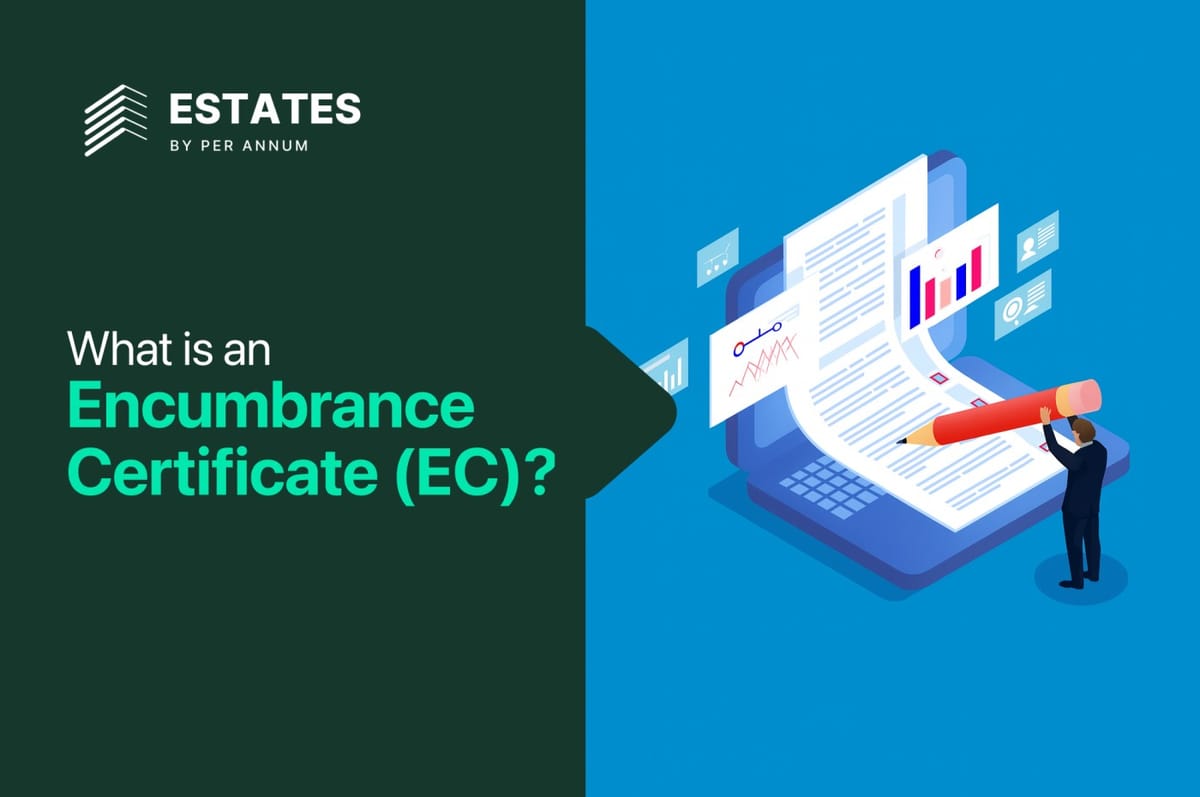
Buying property is one of the biggest financial decisions most people make. An Encumbrance Certificate (EC) is one of the single most important documents you must verify before you sign papers or take a home loan. It is the official record that shows whether the property has any registered liabilities, mortgages, liens, transfers or other legal entries that could affect your ownership. Treat the EC as a property’s financial history ledger: it tells you what has been done on the title that has been recorded with the registrar.
This article explains, in plain terms and with practical steps, what an EC covers, why it matters, how to check it online, its limits, and what to do if you find issues.
What does an Encumbrance Certificate (EC) contain?
An EC is a certified extract from the sub-registrar’s register of documents. For a specified time window, for example, 1995–2025, it lists all registered documents that affect the property: sale deeds, gift deeds, mortgages (loans), release deeds, partition deeds, lease deeds, and court-ordered entries that were registered. Where such entries exist, the EC will show the document reference (book / volume / page), the parties, the date and a short note of the transaction type.
What the EC does not show is equally important: it does not capture unregistered agreements, oral claims, private liens not recorded at the sub-registrar, revenue-record issues that are not registered documents, or certain court disputes that are not entered into the land-records register. That is why the EC is necessary but not always sufficient on its own.
Why the EC matters: From an investor’s and buyer’s point of view
There are three practical stakes that make the EC indispensable.
First, lenders will almost always ask to see an EC spanning a long period (commonly 12 to 30 years, depending on the bank and the property). Banks look for clear historical title and absence of prior mortgages or encumbrances that could impair their security.
Second, the EC validates whether the seller has clean, marketable title. A fresh sale deed alone means little if earlier mortgages or attachments remain on the title. The EC gives you the chain-of-registrations you can reconcile.
Third, the EC is an early fraud-detection tool. If a property has a registered mortgage or multiple transfers in a short spell, it raises questions: was the seller servicing a loan? Were there title disputes? Early detection lets you ask for clarifications, demand discharge documentation, or walk away.
How to check EC online?
Most Indian states have digitised land-registration services. The mechanics differ across portals, but the logic is the same: identify the correct sub-registrar jurisdiction, use a property identifier (survey / plot number, sub-division, document number or old deed reference), specify the date range you want, and retrieve the EC.
A general workflow that works across most portals:
- Identify the sub-registrar/SRO where the property has been registered historically. The EC must be pulled from the SRO that covers the plot or building.
- Visit the SRO/IGRS/registration portal for that state (for example, Kaveri for Karnataka, TNREGINET for Tamil Nadu, IGRS Telangana for Telangana, etc.). If you are unsure of the SRO, ask the seller for the last registered deed (which will note the SRO).
- On the portal, use the EC or document search option. Provide the property identifiers (survey no., plot no., Khatian / Khatauni where applicable) and the date range you want the certificate for.
- View the on-screen EC. Download the PDF if the portal supports it; otherwise note the document references and obtain a certified copy at the SRO.
- Read entries carefully: note mortgages, release deeds (which show a loan was discharged), and repeated transfers. Match document numbers and parties against the title chain provided by the seller.
If you do not find an online entry, it is either because older records are not digitised (requiring an SRO visit) or because there are legitimately no registered transactions in that period (a Nil EC).
How banks and buyers use the EC in practice?
When lenders ask for ECs, they typically want a continuous span that covers the last several transfers, the idea is to see the entire ownership chain and any encumbrances. For a resale, banks often insist on an EC from the date of first sale (or a long look-back of 12-30 years). For newly constructed units that were created after a land parcel was subdivided, banks may require ECs for the parcel and the developer’s title chain.
From a buyer’s perspective, always reconcile the EC entries with the seller’s sale deed. If the EC shows a mortgage that the seller claims is paid, ask for a registered release deed, a document that proves the bank discharged the mortgage. If you see multiple quick successive transfers, ask why: it can be a sign of speculative flipping or of an unsettled title.
Common red flags to watch for in an EC
Spotting issues in an EC is a skill. The main red flags are:
- Existing mortgage entry without a release deed. This indicates the property may still be security for a loan.
- Multiple electronic or physical caveats/attachments. These may indicate a court order or tax attachment.
- Frequent transfers in a short time span. Can indicate title instability or circular transactions.
- Discrepancies between names on EC and title deed. Minor name variations are common; however, major mismatches or missing intermediary transfers require explanation.
- Absence of expected entries. For example, if a seller says they purchased the property in 2010 and the sale deed is registered, the EC must show that deed in the range you requested.
If you find any red flag, demand supporting documents (release deeds, No Objection Certificates, court orders) and, if necessary, involve a lawyer for verification.
Limitations of an EC
The EC is an extract of registered instruments, but it is not a substitute for a title search. A title search checks the provenance of ownership beyond just registered documents: revenue records, mutation entries, encroachments, physical possession, pending litigation, and compliance with zoning/land-use rules. Fraudsters sometimes hide problems in informal side-agreements; a title search plus site visit helps uncover those.
In short, the EC is necessary but not sufficient: treat it as the first, critical filter in a larger due diligence process.
Checking EC online: State-specific nuances
Although the concept is uniform, the portals, field names and data availability vary:
- Some states provide search by document number and downloadable PDFs for free. Others permit only viewing online and require a nominal fee or a certified copy request at the SRO.
- Older records in many states are not fully digitised; you may need an SRO visit for certified historic ECs (especially for spans beyond 20–25 years).
- Certain states issue a Form 16 (Nil EC) explicitly when no registered documents are found; other states use the same EC template and mark “No encumbrances” inside it.
- When shopping for a property in the Delhi NCR region, note that multiple jurisdictions (Noida Authority, Gurgaon/ Gurugram SROs, Delhi SROs) can be involved; confirm the correct sub-registrar.
If you want, I can provide the direct EC portal links for a specific state (for example: Karnataka, Maharashtra, Tamil Nadu, Uttar Pradesh or Telangana) and a short how-to for that portal.
Practical checklist before you sign
Before you move ahead with purchase or loan processing, use this simple due-diligence checklist:
- Obtain an EC for the longest reasonable span (12-30 years) from the correct SRO.
- Reconcile each EC entry with the seller’s title chain and ask for registered release deeds where encumbrances are shown.
- Confirm names, addresses and property identifiers match across EC, sale deed, property tax receipts and mutation record.
- Check for pending litigation or caveats with the local civil court or revenue office if there are suspicious entries.
- If any ambiguity remains, get a lawyer’s title opinion and a property search report.
- For home loan borrowers: provide the bank with the certified EC and copies of release deeds; do not let the lender rely on an unsigned or informal EC.
Frequently Asked Questions (FAQs)
Q1 - How far back should i request an EC?
A - Banks often ask for 12-30 years. As a buyer, request the longest span available to fully see the chain of title, a 20 to 30 year EC is ideal for older properties, while 10-15 years may suffice for newer developments.
Q2 - Can I get an EC online for any property in India?
A - Most states provide EC services online but the depth of digitisation varies. If online retriveal fails, a certified SRO visit is the fallback.
Q3 - If the EC is Nil, does that guarantee safety?
A - A nil EC means no registered encumbrances in the period requested. It strongly lowers risk but does not prove absolute freedom from any probelms (unregistered claims, pending court matters and yet registered, revenue issues). Always combine EC with title search and mutuation check.
Q4 - How long does it take to get a certified EC from SRO?
A - Often three to seven working days for the certified hard copy; many portals provide instant downloads for recent years.
Read more

Top 5 Areas in Bangalore with the Highest Rental Yield (2026 Guide)
Bangalore’s real estate market has evolved from being purely end-user driven to becoming one of India’s strongest rental markets. With a steady inflow of IT professionals, startup founders, consultants, and multinational employees, rental demand in the city remains structurally strong. While capital appreciation differs across micro-markets, certain locations

Does SEBI Regulate Real Estate Investments Like REITs and SM REITs?
Real Estate in India has traditionally been a physical, privately negotiated asset class. Over the last decade, however, regulatory reforms have created financial market linked real estate investment products that are overseen by capital market regulators rather than state property authorities. This shift has raised an important question for investors:
Why RERA Registration Is Important?
The introduction of the Real Estate (Regulation and Development) Act, 2016 (RERA) marked one of the most significant reforms in India’s real estate sector. Before RERA, buyers often faced delays, lack of transparency, changes in project specifications, and limited legal recourse. RERA was designed to correct these structural issues

How to Convert a Leasehold Property to Freehold in India
Converting leasehold property into freehold gives the owner full title and control over the land and removes recurring ground-rent/lease obligations. The process and cost vary widely by the authority that granted the lease (for example, DDA/land-owning agencies in Delhi, municipal or state authorities in Maharashtra, Jaipur Development Authority,