What are Family Offices Buying in 2026?
When the world's wealthiest investors change direction, the rest of the market usually notices a little later.
For decades, family offices have quietly been some of the world's most influential investors. Unlike mutual funds or hedge funds that chase quarterly performance, they invest with a much longer horizon, often thinking in decades instead of years.
Today, more than 8,000-10,000 family offices collectively oversee an estimated $6-7 trillion in assets globally, making them one of the fastest-growing pools of private capital. Their decisions don't just reflect market sentiment; they often shape it.
The investment landscape they're navigating in 2026 looks very different from even three years ago.
Interest rates remain higher than the ultra-low era investors had grown accustomed to. Artificial intelligence is creating entirely new industries while disrupting existing ones. Geopolitical tensions have made supply chains, energy security and infrastructure strategic assets. Public markets continue to trade at demanding valuations, pushing long-term investors to search for opportunities beyond listed stocks.
Against this backdrop, family offices are changing how they allocate capital.
They're writing larger checks into private companies, financing businesses directly instead of through banks, investing in data centres instead of office buildings, and backing infrastructure that powers the AI economy.
So, where is smart money actually going in 2026?
In Today's Edition, We'll Analyse:
- Why family offices have become one of the world's most influential investor groups
- The biggest shifts happening in their portfolios this year
- Why AI infrastructure is attracting more capital than AI software alone
- The continued rise of private credit and direct lending
- Why infrastructure is replacing traditional real estate
- What retail investors can learn from these long-term allocation trends
Who Are Family Offices and Why Do They Matter?
A family office is a privately owned investment firm established to manage the wealth of one or more ultra-high-net-worth families. While they are often associated with billionaires, modern family offices oversee far more than investment portfolios. They manage estate planning, succession, philanthropy, tax strategy and governance, all with the goal of preserving wealth across multiple generations.
Unlike mutual funds or hedge funds, family offices are not judged on quarterly performance. They can remain invested through market cycles, hold illiquid assets for years and back opportunities that may take a decade to fully mature. This flexibility allows them to invest in areas that many traditional investors either cannot access or cannot afford to wait for.
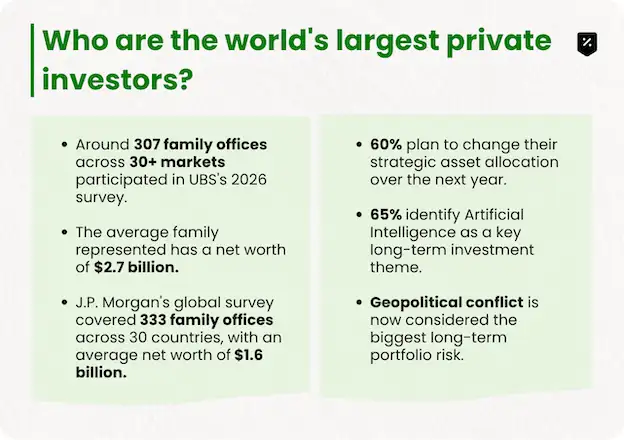
According to the 2026 UBS Global Family Office Report, which surveyed 307 family offices across more than 30 markets, the average participating family had a net worth of US$2.7 billion. More notably, 60% of respondents said they intend to adjust their long-term asset allocation over the next year, reflecting a growing focus on structural themes rather than tactical market moves.
Where Is Capital Flowing in 2026?
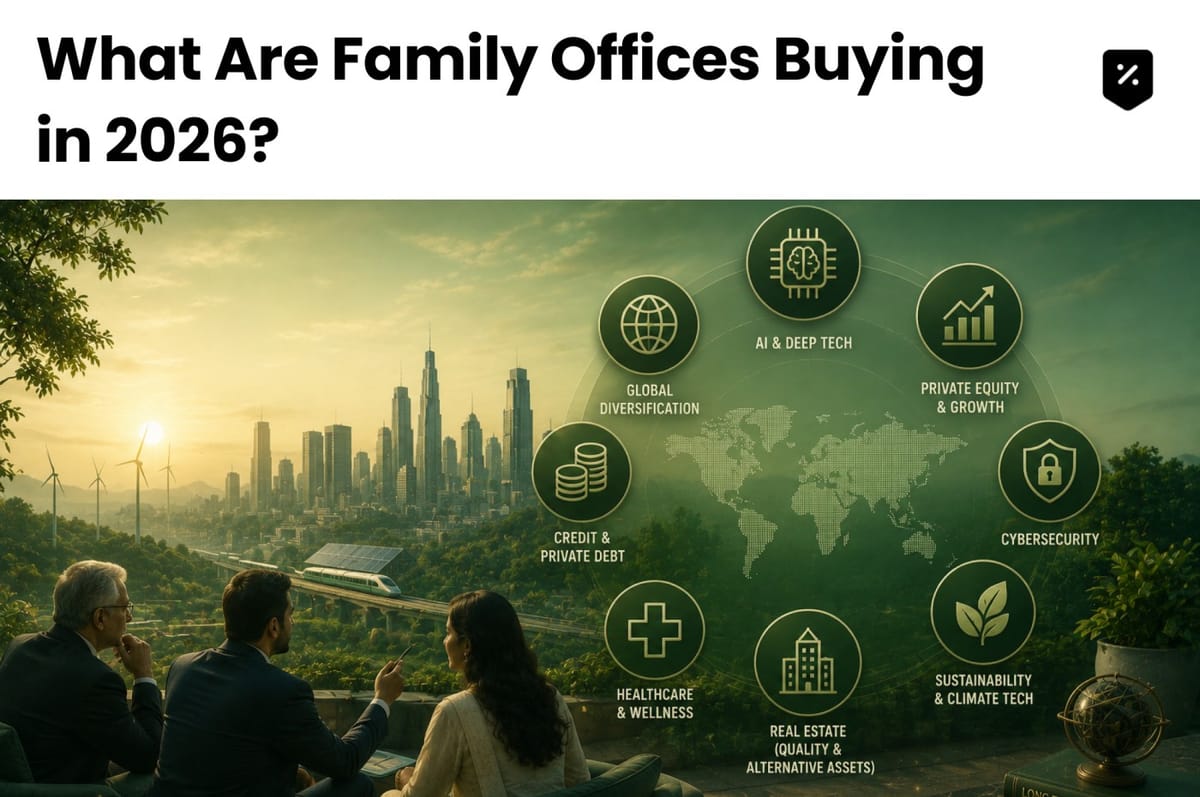
While every family office has its own investment philosophy, the latest allocation data points to a few clear themes. Rather than chasing short-term market trends, they concentrate capital in sectors expected to benefit from structural changes in technology, demographics, infrastructure and the global economy.
Artificial Intelligence & Digital Infrastructure
Artificial intelligence remains the defining investment theme of 2026, but family offices are looking beyond AI software. Their focus is increasingly on the infrastructure that powers the AI economy, semiconductor manufacturers, hyperscale data centres, cloud infrastructure, fibre networks and electricity providers. The logic is straightforward: while individual AI applications may come and go, the infrastructure supporting them will remain essential regardless of which companies ultimately dominate the market. This explains why digital infrastructure has become one of the strongest long-term investment themes among global family offices.
Private Credit
Private credit has evolved from a niche strategy into one of the fastest-growing alternative asset classes globally. As companies increasingly seek financing outside traditional banks, private lenders are filling the gap by providing customised capital solutions while earning attractive yields. For family offices, the asset class offers stable cash flows, portfolio diversification and lower dependence on public equity markets. In a higher interest-rate environment, private credit has become an increasingly attractive source of long-term income.
Healthcare & Longevity
Healthcare is no longer viewed solely as a defensive investment. Advances in biotechnology, artificial intelligence, diagnostics and personalised medicine are transforming the sector into a long-term growth opportunity. Combined with ageing populations across developed markets, these trends are creating sustained demand for healthcare innovation. Family offices are increasing exposure to businesses that improve healthcare outcomes while benefiting from decades-long demographic shifts.
Power, Energy & Critical Infrastructure
The rapid expansion of artificial intelligence has also transformed energy into a strategic investment theme. Every AI model, cloud platform and hyperscale data centre requires enormous amounts of electricity, making reliable power generation, transmission networks and energy storage increasingly valuable. Governments are simultaneously investing in renewable energy, battery storage and grid modernisation, creating long-term opportunities for investors focused on infrastructure rather than short-term market cycles.
Selective Real Estate
Real estate continues to play an important role in family office portfolios, but investment decisions have become significantly more selective. Rather than increasing exposure broadly, investors are focusing on assets supported by long-term demand such as logistics parks, data centres, life sciences campuses and premium residential developments. Segments facing structural challenges, including parts of the traditional office market, are receiving far more cautious attention.
Defence & Cybersecurity
Rising geopolitical tensions have pushed defence and cybersecurity into mainstream investment portfolios. Increased government spending on national security, satellite communications, cyber resilience and critical infrastructure protection has created opportunities in sectors once considered niche. As geopolitical risks become a permanent feature of the global economy, family offices increasingly view these industries as long-term structural investments rather than temporary tactical trades.
Crypto & Digital Assets
Despite growing acceptance of digital assets, family offices continue to approach cryptocurrencies conservatively. Most investors who participate in the asset class keep allocations relatively small, treating crypto as a satellite investment rather than a core portfolio holding. Their cautious approach reflects a broader philosophy of diversification, where emerging opportunities are explored without allowing any single theme to dominate overall portfolio construction.
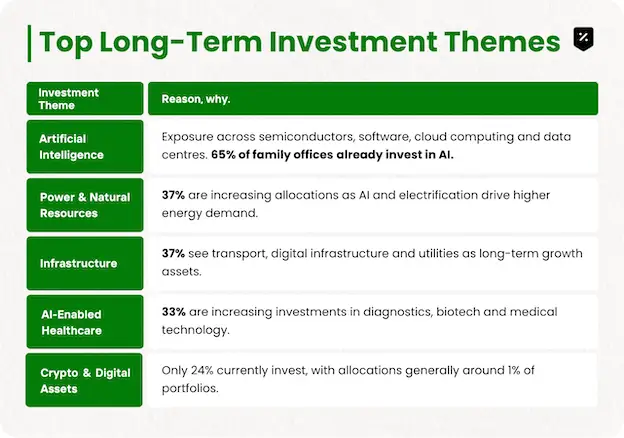
The common thread: Family offices are investing less in short-term market narratives and more in the infrastructure, services and industries that enable long-term economic growth.
What Can Individual Investors Learn?
Most investors won't have direct access to private equity funds, infrastructure assets or institutional private credit strategies. But the principles behind family office investing remain remarkably relevant.
The first lesson is to focus on structural trends rather than headlines. Family offices invest where they expect demand to remain strong for years, not where excitement is highest today. They also diversify across multiple asset classes instead of relying on a single source of returns, reducing the impact of market cycles on overall portfolio performance.
Perhaps the most important takeaway is their willingness to invest in the businesses enabling long-term change rather than only the companies receiving the most media attention. Whether it's data centres powering artificial intelligence, energy infrastructure supporting electrification or healthcare businesses serving ageing populations, the biggest opportunities often lie beneath the surface.
Closing Thoughts
Family office portfolios in 2026 tell a clear story. The world's wealthiest investors are not abandoning growth, but they are becoming far more selective about where they take risk. Capital is increasingly flowing towards industries supported by long-term structural demand, artificial intelligence infrastructure, private credit, healthcare innovation, energy, cybersecurity and critical infrastructure rather than simply chasing the next market trend.
Retail investors don't need billion-dollar portfolios to apply the same thinking. While access to certain investments may differ, the underlying philosophy remains universal: identify durable trends, diversify thoughtfully and invest in businesses and industries that are likely to become more essential, not less as the global economy evolves.