Under-Construction VS Ready-to-Move Properties: Which One Is Better?
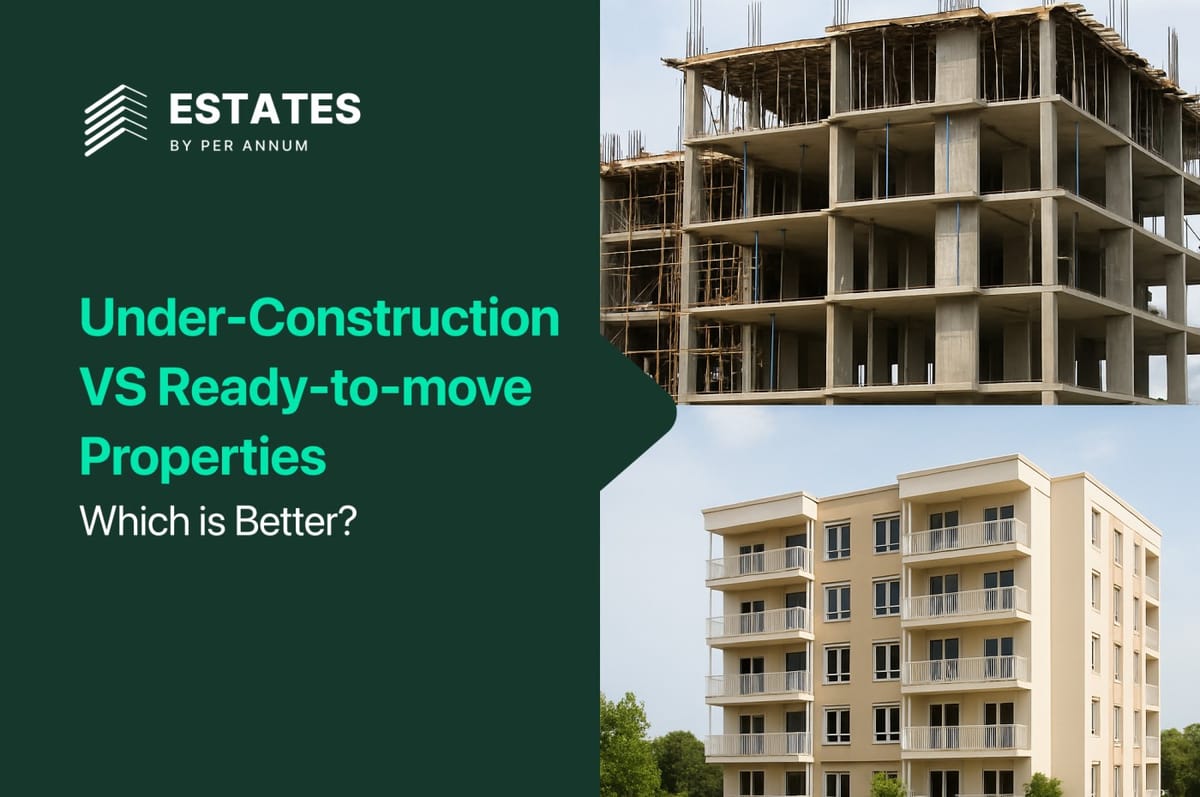
The choice between an under-construction property and a ready-to-move-in home is one of the most common dilemmas for homebuyers and investors. UC units promise lower entry prices and customization; RTM homes offer immediate possession, rental income and no construction risk.
The right choice depends on budget, time horizon, tolerance for risk, financing needs and how soon the property must be usable. This guide compares both options across cost, legal protection, financing, timing, lifestyle and resale; with recent regulatory and market context.
What are Under-Construction Properties?
An under-construction property is a unit sold before the building is completed, payment and delivery are scheduled in stages tied to construction milestones. Developers typically market UC units with attractive “early-bird” prices, flexible payment plans and discounts for larger up-front commitments. Buyers take construction and delivery risk (timelines, quality, approvals), but they benefit from lower initial cost and the potential for capital appreciation by the time the project completes.
What are Ready-to-Move-In Properties?
A ready-to-move property is a completed unit with an occupation certificate (OC) or completion certificate (CC) in place. Buyers can occupy immediately, rent it out for income, or resell without construction delays. RTM homes typically cost more per sq.ft. than UC units because the buyer pays for realized construction, immediate utility and lower execution risk. RTM purchases simplify financing and avoid pre-EMI interest burdens.
Pros & Cons: Under-Construction & Ready-to-Move Properties
Key Decision Factors:
Time Horizon:
If you need to move in within a year or two (due to job shift, family reasons, rental income), ready-to-move makes sense. If you are buying for a medium to long-term horizon (4-8 years or more), under-construction may offer value.
Risk Appetite & Developer Credibility:
Under-construction demands strong confidence in the builder's track record, regulatory compliance (RERA registration) and escrow funding transparency. If you are risk averse, ready-to-move reduces exposure.
Explore: What is RERA Act and Why is it Important?
Market and Location Growth Potential:
Under-construction in emerging micro-markets may give higher appreciation if infrastructure is catching up, but risk is higher. Ready-to-move in mature areas gives certainty but less upside.
Lifestyle Needs:
If you want immediate occupancy and want to inspect the unit, ready-to-move wins. If you are willing to wait and want newer amenities/customisations, under-construction may be better.
Who Should Choose What?
Under-Construction:
- Buyers who are patient and can wait for completion (3–5 years or more).
- Investors targeting capital appreciation rather than immediate occupancy.
- Buyers who are ready to take some risk for a lower entry price and customisation options.
- First-time buyers needing flexible payment plans and who can manage interim cash flows.
Ready-to-move in Properties:
- Individuals or families needing immediate occupancy or relocation.
- Buyers wanting rental income from day one.
- Risk-averse purchasers who prefer certainty over potential discount.
- Situations where infrastructure and neighbourhood are already established.
Legal & Regulatory Factors
Whether UC or RTM, a buyer must do due diligence:
- Check RERA registration (for under-construction projects) and project updates on state RERA portals.
- For ready homes, verify Completion Certificate (CC) or Occupancy Certificate (OC) issued by development authority.
- Check title records, encumbrance certificate, approved plan, tax receipts.
- For under-construction, verify that payment plan is construction-linked and escrow compliance is followed (some states mandate 70 % funds in escrow).
- Ensure GST / tax implications are understood: UC units invoke GST; ready units may not.
- Check timeline clauses, penalty for delay and dispute resolution provisions.
Explore: What is RERA Act and why is it important?
Red Flags & Buyer Mistakes to Avoid
- Developer with no track record or projects delayed previously, huge risk for under-construction.
- Payment plans that ask for huge upfront capital while few milestones have been reached.
- No clear specification of materials, amenities or facing/direction in the booklet yet signed.
- Under-construction projects in locations with poor connectivity or lacking infrastructure promises.
- Ready-to-move projects with ambiguous documentation: missing OC/CC, unclear maintenance records, hidden defects.
Budget Comparisons & Payment Schedules
- Under-construction: Example: 10% booking, 20% foundation complete, 30% slab up to X floors, remaining 40% on possession. Payment spans 2-4 years.
- Ready-to-move: Payment quicker, loan disbursement full or near full, possession immediate. You begin paying full EMI or using home immediately.
- Cost wise: If a ready unit in a locality costs ₹1 crore, a similar under-construction unit may cost ₹70-90 lakhs (10-30 % less) depending on stage and developer.
Frequently Asked Questions (FAQs)
Q1 - Can Under-Construction properties give higher returns?
A - When bought in the right location, at an early stage, with a strong developer and infrastructure envelope, underconstruction properties tend to give higher returns than a ready to move in unit.
Q2 - Does under-construction attract GST?
A - Yes, under-construction residential units are subject to GST (e.g., 5% returns in many cases) whereas ready homes (completed and registered) are typically exempt.
Q3 - Can I negotiate more on under-construction vs ready to move?
A - Under-Construction developers need early buyers, they may offer flexible payments, discounts, large floor overlooking features. Ready homes have less negotiation room because possession and risk is transferred to the buyer.
Read more

Top 5 Areas in Bangalore with the Highest Rental Yield (2026 Guide)
Bangalore’s real estate market has evolved from being purely end-user driven to becoming one of India’s strongest rental markets. With a steady inflow of IT professionals, startup founders, consultants, and multinational employees, rental demand in the city remains structurally strong. While capital appreciation differs across micro-markets, certain locations

Does SEBI Regulate Real Estate Investments Like REITs and SM REITs?
Real Estate in India has traditionally been a physical, privately negotiated asset class. Over the last decade, however, regulatory reforms have created financial market linked real estate investment products that are overseen by capital market regulators rather than state property authorities. This shift has raised an important question for investors:
Why RERA Registration Is Important?
The introduction of the Real Estate (Regulation and Development) Act, 2016 (RERA) marked one of the most significant reforms in India’s real estate sector. Before RERA, buyers often faced delays, lack of transparency, changes in project specifications, and limited legal recourse. RERA was designed to correct these structural issues

How to Convert a Leasehold Property to Freehold in India
Converting leasehold property into freehold gives the owner full title and control over the land and removes recurring ground-rent/lease obligations. The process and cost vary widely by the authority that granted the lease (for example, DDA/land-owning agencies in Delhi, municipal or state authorities in Maharashtra, Jaipur Development Authority,