India Got Shut Out of the World's Biggest IPO?
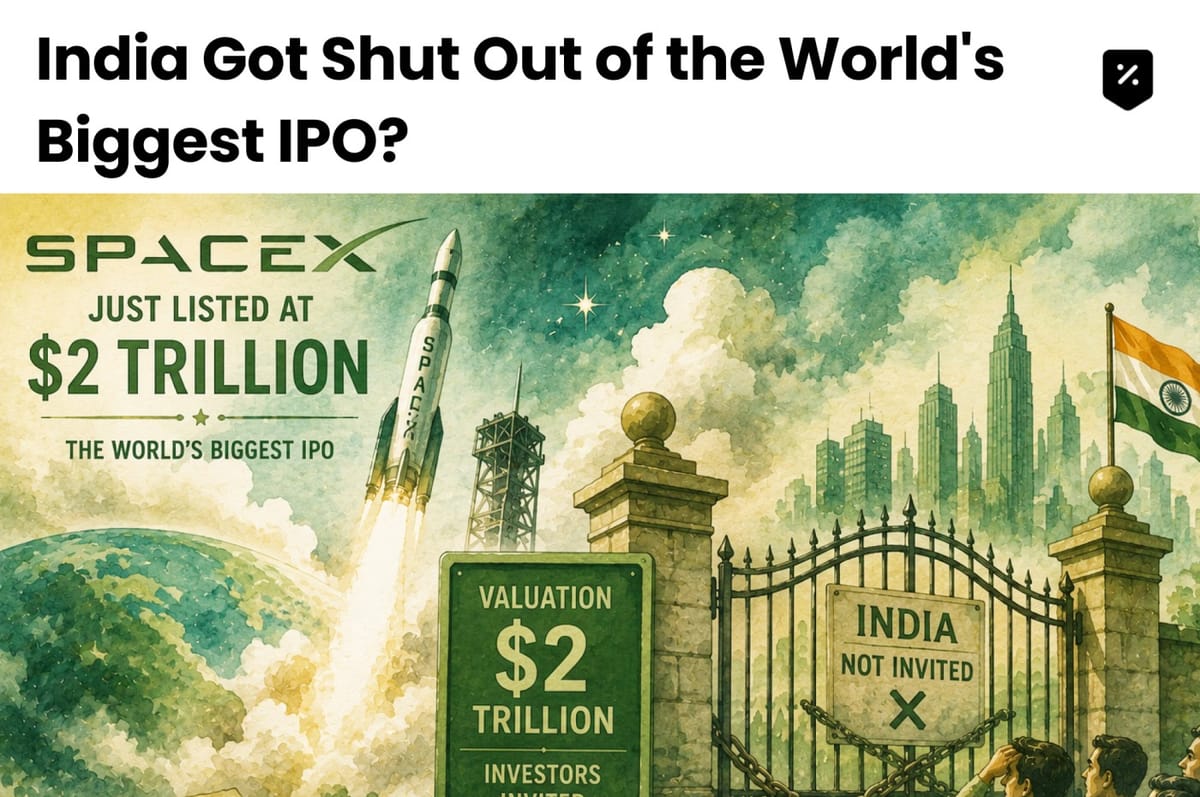
If your social feeds looked anything like mine this weekend, they were inundated with rocket emojis, stock charts, and breaking tickers. On June 12, 2026, Elon Musk finally took the unthinkable plunge, bringing SpaceX public.
The raw statistics from the debut are astonishing:Trading under the ticker SPCX on the Nasdaq, the company raised a whopping $75 billion in capital, more than doubling the record $49 billion floated by Saudi Aramco in 2019 to become the largest IPO in corporate history.
The stock, priced at $135 per share, immediately established a base valuation of $1.77 trillion. Hours after the opening bell, aggressive secondary market buying pushed the stock beyond $150, launching SpaceX clean over the $2 trillion market cap threshold on day one.
But here is the structural nuance the local financial media is entirely skipping over: If you are a retail investor sitting in India, you were locked out entirely from the primary allocation. While underwriters like Goldman Sachs set aside an unprecedented 30% of the issue ($22.5 billion) strictly for retail investors (on platforms such as Fidelity, at account minimums lowered to $2,000), the retail application list was limited only to US, UK, EU, Australia and Canadian citizens. The biggest, most anticipated retail wealth generation event in recent financial history was launched, and Indian savers were sidelined.
In this article, we break down:
- The 94x Sales Multiple: The enormous premium baked into the $1.77 trillion initial price.
- The December Time Bomb: Why the expiration of employee and insider lockups is a volatility trigger in late 2026.
- The Three-Headed Beast: The business segments that you are truly buying at SPCX.
- The Indian Proxy Bet: How Indian investors can get direct, listed exposure to the SpaceX ecosystem through domestic infrastructure stocks.
Segment 1: The Thermodynamic Valuation Trap
Let's look beyond the Mars hype and consider the financial realities SpaceX revealed in its regulatory S-1 filing. While consolidated financial results showed SpaceX raking in $18.7 billion in revenues for the full fiscal year of 2025 (a healthy 33% growth from 2024), hyper-aggressive investment in deep-tech infrastructure resulted in an immense net loss of $4.9 billion, more than wiping out the modest $791 million net profit from 2024.
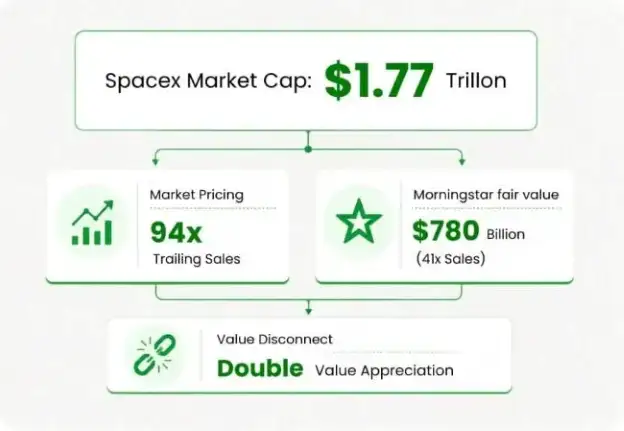
At its current public valuation of $1.77 trillion, investors are paying a sky-high Price-to-Sales (P/S) multiple of roughly 94x, far exceeding even the widely debated multiples of tech giants like Nvidia or Palantir. This extraordinary multiple has divided the world's most astute institutional investors.
- The Bear Case: Independent research house Morningstar values the company at a much more grounded $780 billion (about $58 per share), arguing the current public price is "materially overvalued" and that the market is willing to pay twice the intrinsic value of the company.
- The Bull Case: In contrast, thematic investors like ARK Invest and Baron Capital consider the entry price to be attractive, projecting the company's total addressable market will grow to $28.5 trillion and its valuation will exceed $2.5 trillion by 2030. The difference between these two estimates is wider than the market capitalization of Reliance Industries itself.
Segment 2: The Three-Headed Operating Beast
Buying a share of SPCX isn't like buying stock in a traditional rocket company. You're investing in a complex, cross-subsidized technology conglomerate wrapped in a single stock. Your investment is split between three main operating segments:
- Starlink (The Cash Engine): This segment generates predictable, software-like profit margins. Starlink has expanded to more than 12 million active global users across 160 countries, generating billions in high-margin, recurring satellite broadband revenue.
- The Launch Business (The Monopoly): SpaceX currently dominates the orbital launch market, accounting for over 80% of US launches and about 90% of commercial launches. With an impenetrable competitive moat, it launches more rockets annually than every sovereign nation on the planet combined.
- XAI & Starship (The Cash Burn): These are the high-risk, high-reward segments. The enormous capital required to develop the Starship fleet and implement advanced AI integration on the factory floor is the primary driver of last year's $4.9 billion net loss.
Segment 3: The December Insider Time Bomb
If you plan to circumvent the retail lockout by buying SpaceX stock aggressively on the open market now, through international investing apps or GIFT City accounts, take a careful look at the listing prospectus regarding lockup periods. Because this was a primary capital raise with zero existing shares offered for sale, SpaceX's early institutional investors, venture capitalists, and long-term employees are unable to sell any of their holdings until a regulatory lockup period (typically 90 to 180 days) expires.
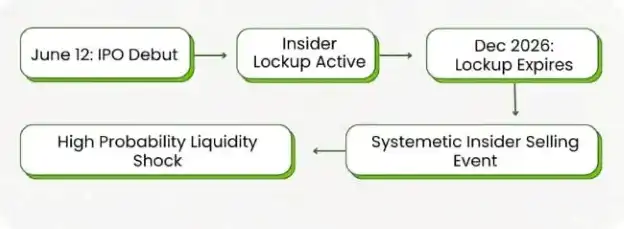
Elon Musk retains 85% of voting control through Class B shares, and early VCs who have held illiquid private shares for nearly a decade have a fiduciary duty to return cash to their investors. When the lockup periods expire in December 2026, a flood of insider shares, valued at billions of dollars, will hit the public market simultaneously, causing a significant liquidity shock. Mark your calendars for December; a large, technical price correction is highly probable.
Segment 4: The Indian Proxy Arbitrage
For Indian investors seeking exposure to the SpaceX ecosystem without paying an exorbitant 94x US tech multiple, domestic corporate boards have quietly provided an alternative investment channel.
Both Reliance Jio and Bharti Airtel have established strategic partnership frameworks to integrate Starlink's constellation into their domestic terrestrial networks, pending approval from the Indian regulatory authorities for commercial spectrum clearance.
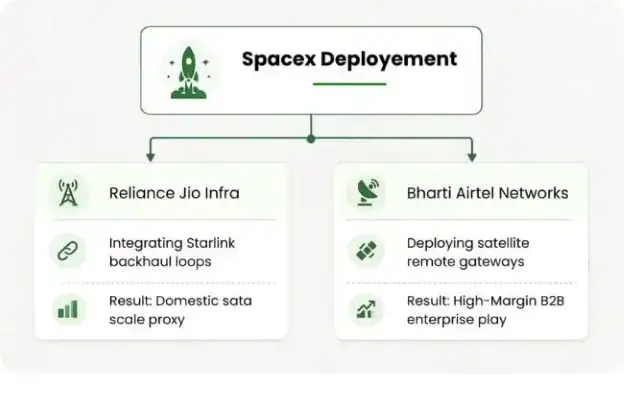
Instead of investing in a speculative, peak-priced US tech listing, smart money in India is betting on the domestic infrastructure that will serve as SpaceX's exclusive toll booths for its data commercialisation efforts in the Indian subcontinent.
The Bottom Line
SpaceX is undoubtedly a revolutionary and structurally dominant engineering firm. However, an outstanding company can become a destructive investment if purchased at an unreasonable price. Given the primary retail allocation is closed to Indian investors, an insider selling event is looming in December, and independent valuations suggest the stock is trading at a 100% premium, there is no need to rush. Let the global retail hype settle, let the institutions come to grips with the 94x multiple, and wait for the December lockup expiration to remove the speculative froth.