India's Next Billion-Dollar Industry Might Surprise You


If you track institutional venture capital flows or retail brokerage reports in India right now, the narrative is completely monopolized by high-velocity digital tech: artificial intelligence infrastructure, regional quick-commerce networks, and high-end consumer electronics manufacturing.But while short-term speculative capital is busy chasing 90x sales multiples on volatile software applications, an absolute demographic inevitability is quietly playing out in the background.
According to data compiled by the Ministry of Health and Family Welfare alongside a joint JLL-ASLI structural industry breakdown, India is home to the world's second-largest elderly population, with over 156 million citizens aged 60 or above. By 2050, that demographic baseline is projected to more than double, exploding past 346 million individuals-effectively turning 21% of the country's total population into senior citizens.
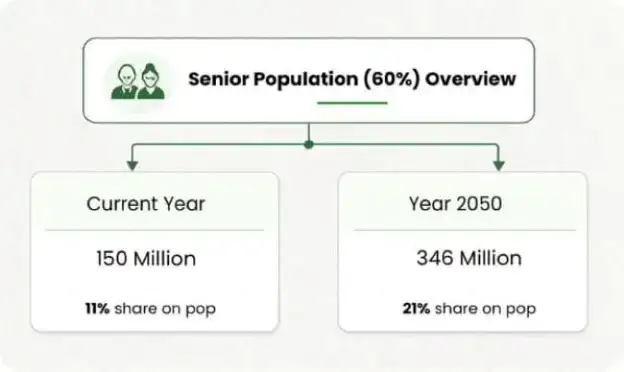
Yet, despite this massive structural demand curve, organized senior living infrastructure remains practically non-existent. The current market penetration rate for specialized retirement communities sits at a microscopic 1.3%. For investors willing to look past the standard tech-bro hype, this severe supply-demand mismatch represents one of the largest unhedged structural arbitrage opportunities of the next two decades.
In this edition, we'll analyse:
1. The 1.3% Penetration Floor: How India's retirement infrastructure backlog creates a massive structural vacuum compared to global mature markets.
2. The Nuclear Family Dislocation: The irreversible behavioural breakdown of traditional multi-generational urban housing.
3. The $7.7 Billion Cap Table: The scale of institutional private credit and development capital moving into the "Silver Economy."
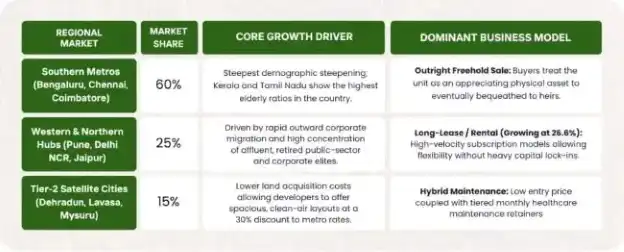
4. The Two-Headed Operating Model: Analysing the corporate economics of Freehold Sales versus high-yield Long-Lease rentals.
Segment 1: The Nuclear Dislocation
For generations, the default financial and social insurance policy for aging parents in India was the traditional joint-family structure. That historical safety net has been completely dismantled by modern white-collar corporate mobility.
Long-term urbanisation and the rapid globalisation of the Indian tech and services sectors have systematically pulled working-age adult children away from parental hometowns. Whether migrating to Tier-1 domestic hubs like Bengaluru and Gurgaon, or moving overseas to the US and Europe, younger generations are executing an irreversible shift toward nuclear family setups. This has left a massive, wealthy cohort of urban seniors living completely isolated.
According to corporate user surveys across major metros, approximately 25% of urban seniors are now living completely alone. They aren't looking for standard real estate; they are hunting for a managed operational ecosystem that can handle high-voltage electrical compliance, housekeeping, dietary security, and physical safety without requiring active family oversight.
Segment 2: Integration of High-Margin Care
When a developer builds a standard luxury condominium, their responsibility ends the moment the keys are handed over and the resident welfare association takes charge. In the senior living matrix, the physical apartment is simply the wrapper; the real value engine is the specialised healthcare integration.
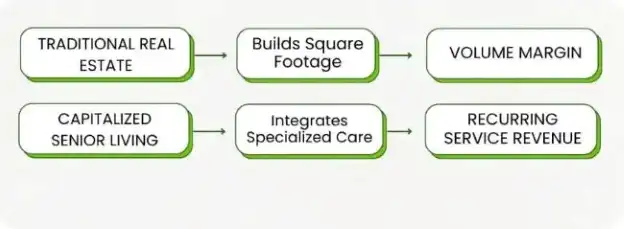
As the 65-to-74 age cohort expands at an accelerated clip, the market is fracturing into two distinct service sub-sectors:
- Independent Active Living (64.5% Market Share): Tailored for healthy, asset-rich retirees. These projects feature specialised physical layouts-zero-step entries, grab bars, wide corridors, and anti-skid tile infrastructure-combined with recreational clubhouses and basic emergency response systems.
- Assisted Living & Memory Care (Growing at a 27.3% CAGR): This is where high-margin corporate execution happens. These facilities embed full-time clinical teams, specialised dementia wards, and telemedicine backhaul loops directly onto the residential floor plan, turning a real estate project into an essential, recession-proof medical utility.
Segment 3: The $7.7 Billion Institutional Pivot
The financial validation of this model is already visible on institutional balance sheets. JLL reports that India's senior housing market value is projected to skyrocket from its current baseline up to $7.7 billion (approximately 64,500 crore) by 2030.
This macro expansion has caught the attention of global private equity and domestic corporate developers who realise that standard residential markets are facing premium inventory gluts. Leading players like Ashiana Housing are already projecting that senior living configurations will supply up to 50% of their total corporate revenue within the next three fiscal years. Concurrently, global operators like Columbia Pacific Communities are deploying multi-million dollar capital rounds to expand operations across Tier-1 nodes, establishing dedicated asset-management frameworks that treat retirement communities not as volatile real estate speculation, but as long-term, high-yield recurring cash flow streams.
The Bottom Line
If your investment thesis is built exclusively on chasing whatever topic is trending on financial news channels this morning, you will likely end up buying into overextended tech multiples right before a market correction.But if you analyze the raw, slow-moving macroeconomic tectonic plates, the aging of the Indian population is an absolute mathematical certainty. The current 1.3% infrastructure penetration rate cannot withstand the wave of 340 million seniors heading our way. For long-term wealth allocators, developers, and private equity syndicates, the real play isn't trying to guess which software app wins the next VC cycle. It's building the physical, high-margin, healthcare-anchored infrastructure that the wealthiest generation in Indian history will legally require to live out their lives.