Why “Make in India” Is Hitting a Structural Wall
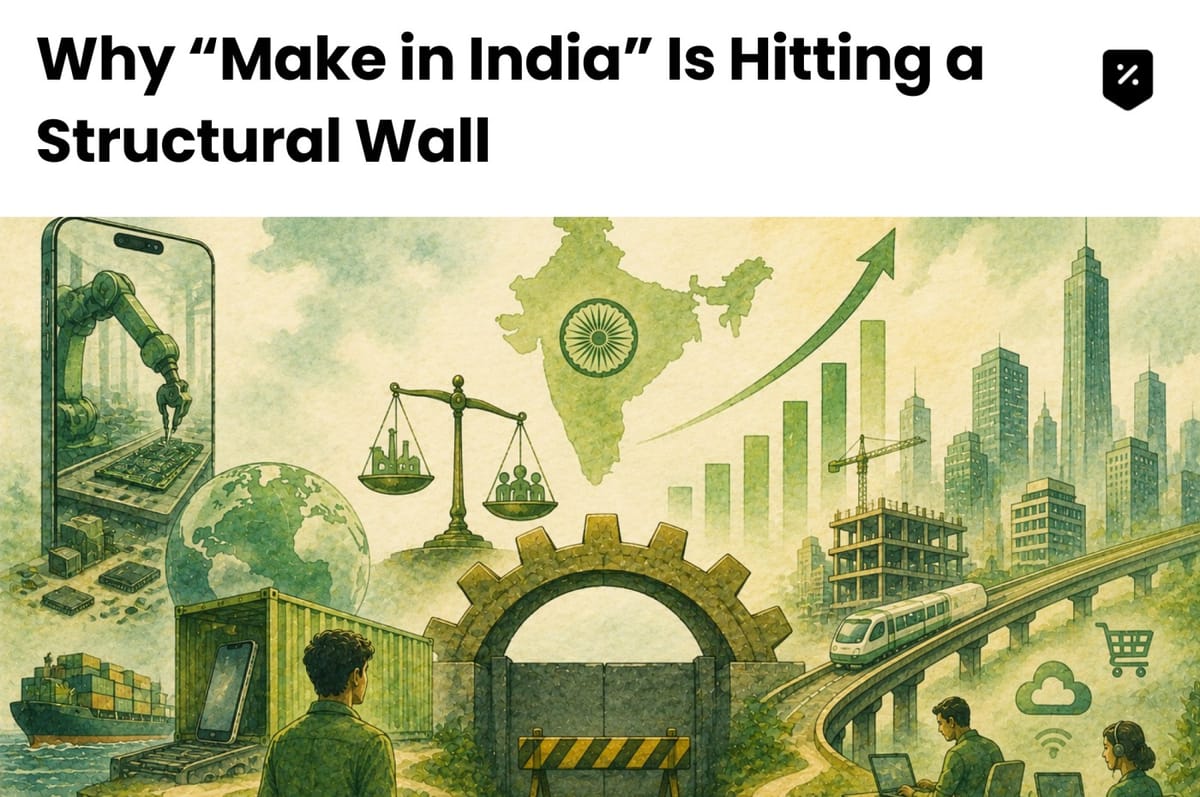
With massive PLI schemes and a $30B smartphone export surge, India’s share of manufacturing to GDP is stuck between 13%-14%, a far cry from its 25% goal. Data-driven insight into why domestic GVA growth is outstripping local factories. India’s story of industrial manufacturing is told through headline triumphs: the nation's local Apple suppliers shipped $30 billion worth of smartphones last fiscal year; electronics has become a top three export category; and the nation's semiconductor infrastructure is buzzing with mega-factories in development.
But strip away corporate pronouncements and consult the blunt macro numbers from the Ministry of Statistics and Programme Implementation (MoSPI) and the World Bank, and a surprising structure emerges.
Actual share of manufacturing to India's Gross Domestic Product (GDP) has dropped to 13%-down from a 15% peak in 2018. The government's Economic Survey and updated Ministry data estimate a marginal rise to 14.2% based on an 11.5% increase in manufacturing GVA, but this is still far off the 25% target set when the "Make in India" campaign kicked off.
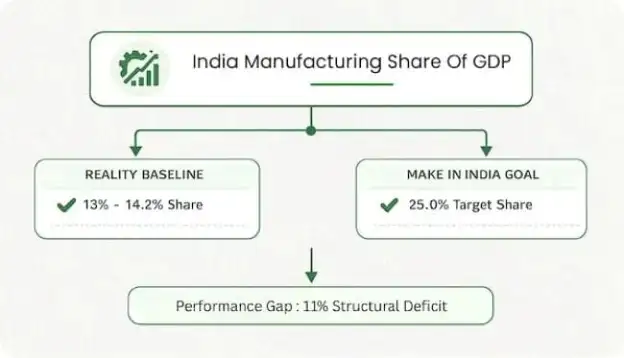
The issue isn't that Indian factories aren't getting larger. The issue is that everything else, domestically, services, construction, rapid digital consumerism, is growing even faster and continues to pull down manufacturing's relative slice of the national pie.
In today's edition, we'll analyse:
- Asymmetric Value: Why high tech-assembly is failing to move the needle on structural GDP.
- Two-Speed GVA Disconnect: Parsing MoSPI's newly revised data series vs. the Index of Industrial Production (IIP).
- Capital vs. Labour Mismatch: The core reason why massive automated factories aren't creating mass employment.
- Medium and High-Tech Pivot: Where the actual value addition is consolidating within the industrial sector.
Segment 1: Smartphone Mirage
The leading industrial achievement to date has been mobile phone manufacturing. In 2025, smartphones displaced diamonds and diesel for the title of India's biggest export; but the headline export number doesn't tell the story of what goes on in that factory.
- Value Loss: because critical components like the processor chip, memory, and sensors are imported from East Asian countries, local value creation within the Indian factories amounts to only 18%-22% of a phone's total cost. An $1000 phone exports with $800 in parts that were assembled domestically. That delivers high export volumes, but shallow domestic GVA value.
- Assembly Hole: The majority of work in India's electronics mega-hubs involves assembling pre-made component parts (Semi-Knocked Down, or SKD) as opposed to designing and manufacturing individual pieces of the phone from scratch (Completely Knocked Down, or CKD).
Segment 2: Two-Speed Macro Ledger
The accounting of manufacturing output in India has recently become more complicated due to an update from MoSPI. To understand the disconnect between factory-level operations and GDP calculations, we must look at two different sets of data:
- The GVA Matrix: The new Economic Survey indicates that real GVA in the Industrial sector expanded 7% year-on-year for the first half of the year, with manufacturing output growth showing 11.5%, driven by structural shifts where medium- to high-tech components now constitute 46.3% of all value created in India.
- The IIP Roadblock: The data that tracks factory floor output tells a different, slower story: for the last two years, various manufacturing use-based categories have pretty much stood still:
The core narrative is a tale of two distinct trends: some industries at the higher end (pharmaceuticals, automotive, metals) are creating significant value, but the masses of consumer-focused factories aren’t gaining much ground.
Consumer Durables 0.22% Sluggish to negative, mirroring the stagnation in urban purchasing for white goods. Consumer Non-Durables +0.48% Barely grew, reflecting depressed rural consumer demand.
Segment 3. Capital vs Labour Rift
The aim to raise India's manufacturing share to 25% of GDP was predicated on a historical parallel with China and South Korea: millions moving from farming to jobs on assembly lines. India, however, is breaking that mold.
Manufacturing now uses significantly more capital than labor.
According to the Annual Survey of Industries (ASI), only 1.96 crore people are employed in manufacturing, out of a total workforce of 64 crore+.
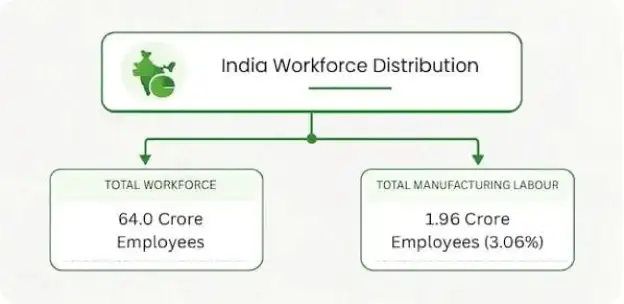
As private credit from non-banks grows at an astonishing 17.3% CAGR, companies are investing in automation and advanced machinery, rather than increasing their headcounts. The modern factory efficiently churns out profits for corporations but is no longer an effective mass job creator for the nation’s ballooning workforce. The Bottom Line If success is defined by its new tech factories, its expanding metals and steel output, and the capacity to assemble global electronics, "Make in India" is successful.
Bottom Line
However, if success is measured against the ambitious goal of rebalancing the entire national economy towards manufacturing, the results tell a compelling tale of stagnation.
Until local factories build deeper supply chains that outpace the services sector and construction, India's GDP slice for manufacturing will remain rooted around the 14% mark. The country is growing its industrial capacity, but turning into a manufacturing-led 25% GDP economy remains elusive.