Is RERA Registration Required For Plots?
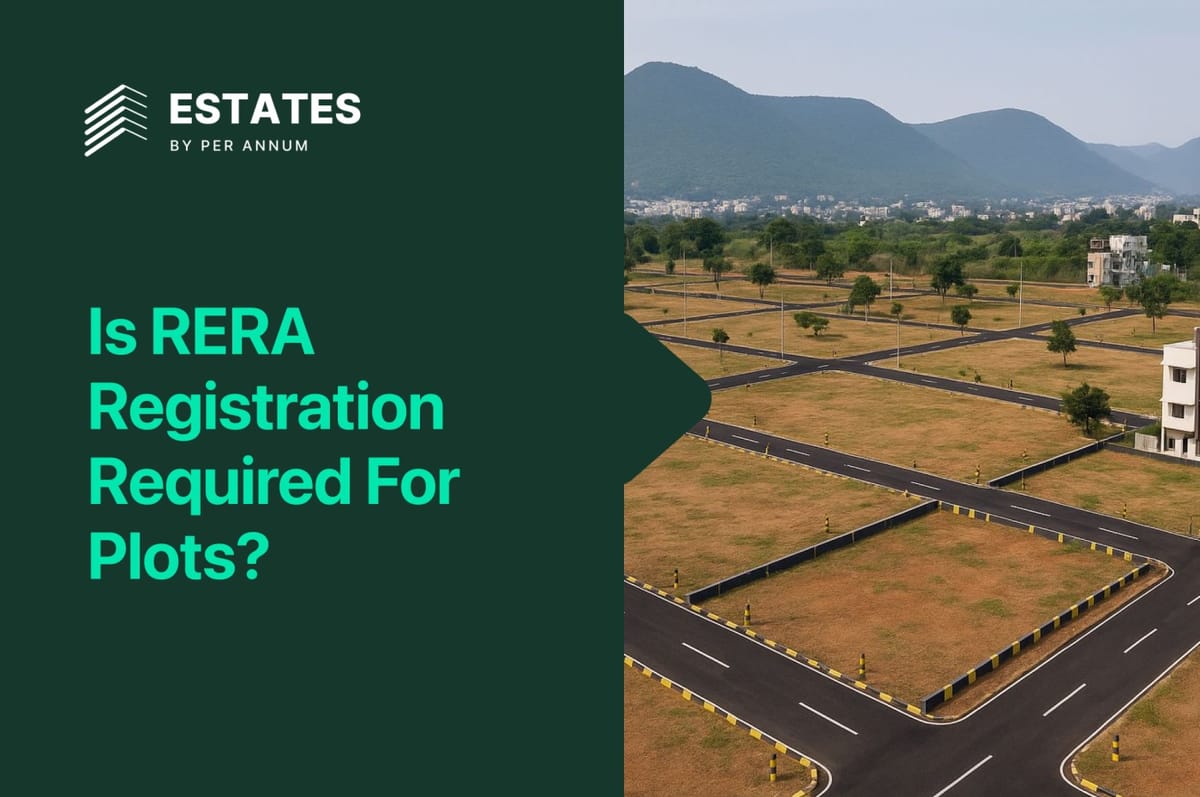
One of the most common assumptions of property buyers is that RERA pertains only to flats and residential housing projects.
Hence, most buyers feel that if they are buying a plot of land then there is no reason why they need to be concerned about the RERA act. Nothing could be further from the truth.
RERA act applies to many plot development projects. In fact, many recent disputes of land sale have been linked to unregistered layout, pending approvals, delayed infrastructure and selling of plots by promoters without mandatory registration.
So, Is RERA registration mandatory for plots?
It actually depends on the kind of sale that you are looking for.
The short and simple answer: Yes, RERA registration for plots is generally mandatory
Section 3 of the RERA Act lays down clearly that no promoter shall advertise, market, book or sell any plot, apartment or building in a real estate project, except the exempted projects mentioned below without having first registered the said real estate project with the respective state RERA authority. So plots fall within the ambit of the RERA Act.
Thus, if a promoter is coming up with a plotted development and plans to sale it, then he requires RERA registration prior to his advertisement or sales activity. The common perception that RERA applies only to flat projects is factually wrong.
When Is RERA Registration Mandatory for Plotted Developments?
A plotted development project is liable for RERA registration when it crosses the threshold defined by RERA Act. RERA registration for plots will be necessary when,
- The area being developed is greater than 500 sq mtrs OR
- The number of units is greater than 8 plots.
When either of these is surpassed then RERA registration for the project is needed prior to booking or advertising of the project to potential buyers.
For instance, if an acre of land has been acquired, it has been developed to include interior roads and has then been plotted for sale as a plotted gated community project, then RERA registration is likely required.
When RERA registration is not required?
The area where confusion arises often.
Not all sales of land will fall under the RERA act. Some of the situations where you might not need RERA registration include,
Single Land Parcel:
If it's a case where a single plot of land is being sold and it's not part of a developed project.
So if you are buying a standalone plot of land from a single owner, and not part of an upcoming or developed plot project then you would generally not need to be concerned with the RERA act.
Agricultural Land sales:
If you are looking to buy a parcel of land which is purely agricultural land and is not part of a developed, plotted project and being sold as farm plots etc.
However, it will fall under RERA if the land has been sub divided and promoted for sale as residential plots.
Plots in small plots project:
Any plot development less than 500 sq meters OR if less than 8 plots are being developed for sale then RERA Registration may not be required although state RERA should always be checked.
Why is RERA Important for plot buyers?
A large number of investors only concentrate on ownership documentation and neglect the important project level registration.
This can prove disastrous. You are not just buying a piece of land when you invest in a plotted project; you are investing in the future road network, drainage, electricity supply, water connection etc. You are often at the mercy of the promoter when these developments are in question.
RERA registration ensures a developer discloses critical project details to the buyer such as:
- Approvals of the layout
- Ownership status of the land
- Timelines for completion of the project
- Status of project approvals
- Financial health of the developer and financial details of the project
- Commitments of construction for the plot development
This leads to increased transparency and accountability from the promoter and significantly reduces risk.
What Happens If a Developer Sells Plots Without RERA Registration?
Selling plots without RERA registration is not just a technical violation. Numerous state RERA authorities have imposed strict penalties on developers for marketing and selling plots without proper RERA registration.
In Telangana, for instance, an investigation revealed that a developer was actively promoting and selling farm plots without obtaining necessary approvals and RERA registration. The state RERA authority took action against them and prohibited further sales activities until all legal requirements were met.
Similar actions have been taken by RERA authorities across various states, warning promoters against using advertisements, social media, brochures, or pre-launch campaigns for unregistered projects. Unregistered plots require extra caution from potential buyers.
How to find if a plot is RERA Registered
Before you sign on the dotted line and transfer any funds, it's crucial to verify if a plot project is RERA registered. The process is quite simple:
- Visit the RERA authority website for the respective state where the project is located.
- Search the project details using the promoter's name, project name, or the registration number of the plot project.
- Once you find the relevant information, compare it with the project brochure. Ensure all details like approvals of the layout, status of infrastructure development, etc. Are correctly reflected.
- You can use RERA registration to get additional information related to the project like the timeline of the project.
Never blindly trust a promoter's word; always check the details yourself using the state's official RERA website. If they claim the project is "RERA approved," ensure they can share the "RERA registration number" and then cross-verify. Note that the appropriate term used in the act is 'RERA registration' not 'RERA approved'.
RERA registration is important, but not the
be-all-and-end-all
It is important to understand that while the RERA registration number signifies an improved layer of protection, it is not a guaranteed sign of a risk-free project.
Buyers still need to conduct their own thorough due diligence and investigate:
- The title of the land
- The Encumbrance Certificate
- Layout approvals for the plotted project
- Land use status
- Existing right of way to the project
- Any pending litigations against the project
- Any special infrastructure that was assured and committed by the promoter.
Real estate experts consistently advise that title verification for any real estate purchase is just as important as verifying the RERA status.
RERA should be seen as one component of the protection measures that a buyer can have, not as the complete shield.
Verdict
Yes, RERA registration is definitely required for most plotted development projects in India.
For RERA registration, the plot must be sold in a developed layout, and if the layout is developed on more than 500 sq. Meters or if the number of units being sold is greater than 8 then RERA registration is a mandatory legal requirement for the promoter to be able to market or sell such plots.
A buyer should verify the RERA status of any plot purchase project, which can act as one layer of security when buying plots, and should be coupled with independent title verification and approval check to ensure the plot purchase is safe and legally sound.