Is Health & Wellness Growing 3-4x Faster Than FMCG?

The previously prevalent optimism around India’s Fast-Moving Consumer Goods (FMCG) market has taken a markedly cautious tone. Recent consumer packaged goods market performance, highlighted in data released by NielsenIQ (NIQ), showcases a market in a peculiar phase of normalization around volume. With an increased disruption in pricing points, and a division in consumption patterns between urban and rural populations, volumes across mass-market Home and Personal Care (HPC) has merely plateaued at 1.9%.
However, when separating mainstream groceries from the specialty health and wellness sectors, we begin to see a significant disparity statistically.
Data aggregated by IMARC Group points towards India’s health and wellness market attaining an absolute market value of $156.0 billion. These niche health and wellness based sub-sectors, comprising everything from functional foods to probiotics for gut health, clean-label dairy, to highly specialized nutritional supplements, have experienced growth rates that have several times the rate of conventional groceries. Some of these categories, boasting strong margins, have delivered individual compound annual growth rates (CAGR) ranging from 10.74% to 14.6%.
In this edition, we'll analyse:
- The Volume Divergence: How mass-market FMCG volume normalisation contrasts with double-digit health sector velocity.
- The Functional Wave: The consumer shift toward food products evaluated for metabolic and nutritional utility.
- Probiotic Infrastructure: The industrial capital allocations expanding nationwide cold-chain distribution loops.
- The Category Performance Matrix: A breakdown of specialised sub-segments, core sales channels, and target urban demographics.
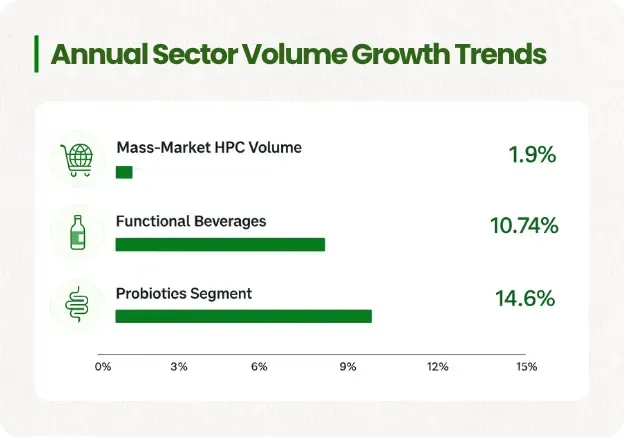
This level of growth demonstrates a gradual, but permanent, shift in where consumers are spending their assets. The Indian urban demographic, now increasingly focused on day-to-day preventive health rather than merely curative approaches, has solidified health and wellness into a central pillar of high-margin corporate revenue.
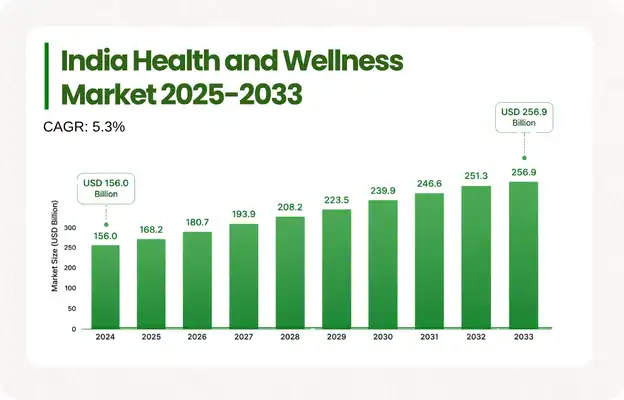
Market Analysis: If you observe the projection chart for the health and wellness market by IMARC (above), you’ll see a relatively consistent, staged increase in the baseline value. By 2033, this market is projected to grow from its present $156.0 billion to $256.9 billion, sustained by a consistent 5.3% CAGR. The reliability of this upward curve underscores the resilience of this sector against the immediate volume-related turbulence plaguing more standard, non-fortified, FMCG goods.
Segment 1: The $6.9 Billion Functional Wave
Today, food is seen much more as functional than purely nutritional; consumer choice is based on attributes such as metabolic regulation, immunity enhancement and glycaemic index optimisation.
Market Leadership: Of all domestic health and wellness products available in the market today, those categorised as functional food products hold the largest share (42%).
Scale: In terms of scale, the domestic functional beverages sub-segment alone accounts for $6.9 billion. Fueled by rising adoption rates, particularly amongst urban affluent, particularly within northern India with a 30% regional share, due to significant disposable income in areas like the Delhi NCR, this category is predicted to hit $18.8 billion by 2034 at a CAGR of 10.74%.
Segment 2: Probiotic Infrastructure & Investment
The exponential growth of India’s probiotics and gut-health ecosystem reflects a substantial shift in strategy. Historically considered niche supplements, value-added probiotic product lines have seen significant attention and investment, prompting major co-operatives and private dairies to rapidly build industrial-scale production capacities.
According to research from Grand View Research, India’s probiotics market has already surpassed $8.31 billion in sales and is anticipated to climb to $25.0 billion by 2031, exhibiting an aggressive 14.6% CAGR. To meet this increased demand, major players in the sector anticipate 11-13% industry growth and are making multi-crore investments in infrastructure development to support distributed temperature-controlled supply chains.
The Better-For-You Category Performance
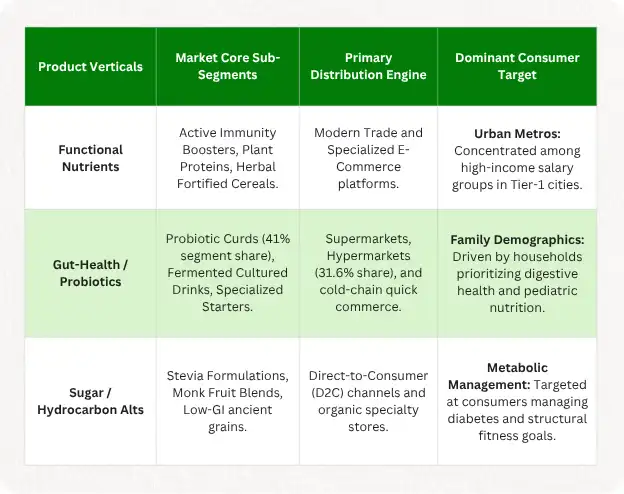
The table below illustrates the current structural landscape of the key specialized health and wellness categories based on aggregated retail sales data.
Key Takeaway
The disparity between the performance of traditional FMCG and the more specialized, health-and-wellness focused sectors provides a critical blueprint for future strategy.
As conventional FMCG companies continue to grapple with price sensitivities and diminished profit margins caused by fluctuating commodity prices, health and wellness products maintain robust profit margins based on a reliable premium pricing strategy. Indian consumers have consistently proven their readiness to invest in goods that clearly communicate ingredient transparency, offer a clean label, and deliver functional benefits.
With capital investments continuing to pour into developing the corporate infrastructure and quick-commerce channels smoothing distribution access across Tier 1 and Tier 2 cities, the growth gap between standard consumer goods and those anchored in wellness is expected to widen significantly. The sector has evolved beyond a fleeting trend into a fundamental economic utility generating billions. The strategic focus for those looking for stable margins has shifted decisively from low-value volume sales in mass FMCG toward establishing a strong position within the burgeoning functional health space that is actively reshuffling the Indian grocery cart.