India's Inequality Is Now Worse Than During the British Raj
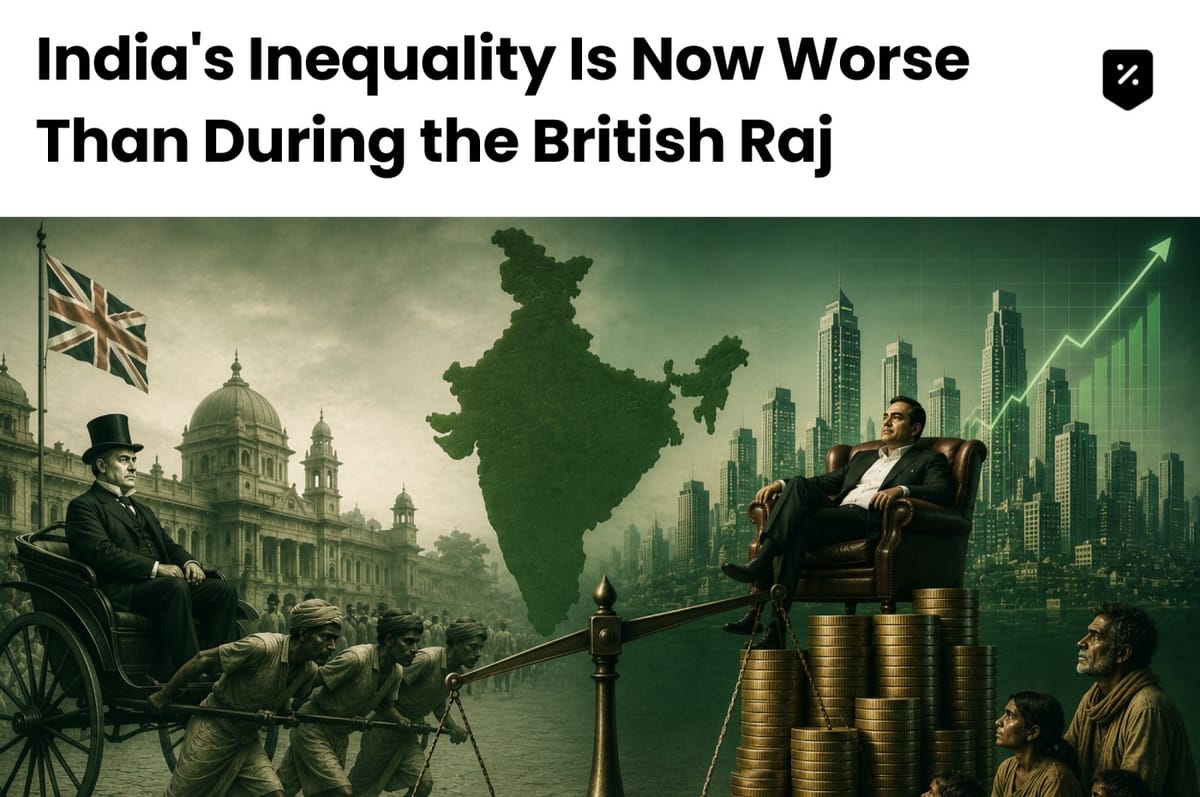
The top-line growth metrics, a yardstick routinely applied to assess the macroeconomic path of the Indian nation, would have it believe the country is set on a robust gross domestic product (GDP) expansion track. Yet a deeper look at the internal income and wealth distributions at aggregate national levels would have the Indian policy apparatus take note: the bottom has become thin, the top has thickened structurally at the upper reaches of the population register.
A comprehensive study by the World Inequality Lab titled "Income and Wealth Inequality in India, 1922-2023: The Rise of the Billionaire Raj," by Nitin Kumar Bharti, Lucas Chancel, Thomas Piketty, and Anmol Somanchi finds economic inequality to be at record highs and the top 1% share of the nation's income to be higher than colonial peaks.
It is, in effect, a slow, but substantial, re-plumbing of the country's economic hardware-capital accumulation has become an increasingly voracious enterprise compared to labor compensation.
In this edition, we’ll analyse:
• The Colonial Baseline Inversion: Top-income concentration today versus the zenith under the British Raj
• The Billionaire Asset Expansion: Tracking ultra-high net worth (UHNW) individuals as a function of net national income
• The Squeezed Middle: How the bottom 40% income share has shrunk over decades
• The Policy Levers: Limitations of progressive taxation and new structural frameworks
Segment 1: Colonial Baseline
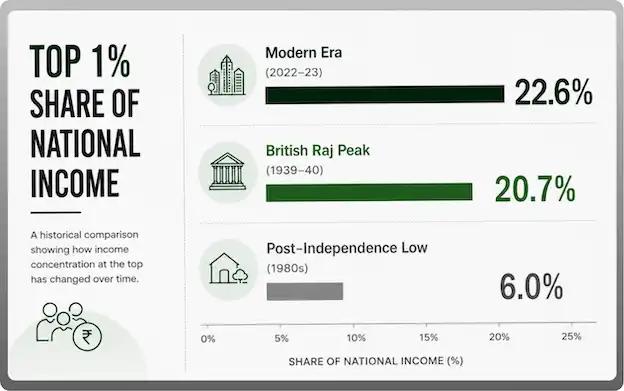
For a comparable benchmark for current concentrations of capital accumulation against historical values, the World Inequality Lab leverages available tax tabulations from the outset of domestic income taxation (1922) against contemporaneous national income account series. The analysis demonstrates a century-long U-shaped curve of top income concentration, wherein:
• The British Raj peak: during the interwar colonial period, the top 1%'s share of pre-tax national income attained a historical maximum of 20.7% in 1939-40.
• Post-independence decline: following independence and subsequent fiscal intervention, it fell consistently, bottoming out around 6% in the early 1980s.
• Modern divergence: following the structural reform program that began in the early 1990s, top concentration reversed sharply, and in 2022-23, the share of the top 1% was 22.6% of the total, officially crossing colonial peaks.
Segment 2: Volumetric Scale of Top-End Capital Accumulation
This trend of concentration at the apex is further magnified when looking at wealth rather than income distribution. The rapid increase in the number of ultra-high-net-worth individuals (UHNWIs) mirrors this rise: from one billionaire in 1991, India saw 52 in 2011, 162 in 2022, and as many as 271 in 2024, according to Forbes billionaire data compiled for the study.
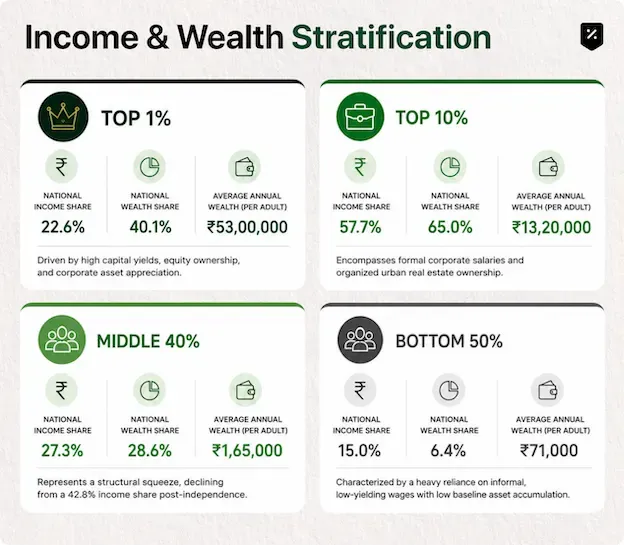
What is more macro-relevant, however, is the aggregate wealth of this elite as a fraction of national income: India’s net national income in 2022 included the net wealth of the country’s billionaires, amounting to a massive 25%, up from less than 1% in 1991. Consequently, the top 1% of adults now holds 40.1% of all the nation's wealth, while the bottom half holds merely 6.4%.
The Income and Wealth Stratification Matrix The following table illustrates how national income and wealth are distributed across various cohorts in modern India based on the integrated World Inequality Lab data.
Segment 3: The Policy Levers
The architecture of India’s fiscal framework under current conditions is tilted toward regressivity.
Key structural policies that typically provide progressive redistributive capacities in industrial economies are either missing or are constrained in implementation:
• Direct Tax Net Insulation: With less than 8% of the workforce being covered by direct personal income taxation, it inherently offers limited leverage to progressively redistribute top-end gains.
• Dismantled Fiscal Controls: the structural fiscal architecture that once enabled direct wealth accumulation controls such as wealth and inheritance taxes are obsolete (wealth tax was abolished in 2015).
• The Proposed “Super Tax” Leverage: the authors of the World Inequality Lab report propose to remedy this fiscal gap and plug in fiscal resources for public goods via a 2% tax on the net wealth of ultra-rich individuals.
This policy lever could generate an estimated 0.5% of India’s national income to be allocated towards enhanced investments in public goods such as education, health, and nutrition.
Bottom Line
The World Inequality Lab’s data points to a systemic re-aligning of the Indian economy toward concentrated capital accumulation. As the aggregate GDP growth remains robust, the widening gulf between the top 1% and the bottom 99% of the nation demonstrates an underlying pattern-modernization dividends are increasingly accruing to a highly capital-dependent elite.
For both capital allocators and economic policy-makers, monitoring the distributive ledger is crucial: if the bottom 40% and bottom 50% of the income share continue their structural descent, India’s potential mass market consumer base faces inevitable ceiling.