Who is India's Real Estate Boom For?


The institutional consensus on Indian real estate is uniform: the sector is sprinting toward a $1 trillion market size by 2030, set to command an unprecedented 20% slice of the nation's GDP.
But if you look at the actual transactional machinery under the hood, the ground reality reveals a structural split. The housing boom is no longer an engine for middle-class asset creation; it has transformed into a high-margin, institutional asset playground.
The industry is printing historic wealth, but it is doing so by executing a brutal squeeze on the domestic salaried professional.
In this edition, we'll analyse:
- The 10% Affordable Floor: The structural collapse of sub-40 lakh housing inventory across the top seven metros.
- The 6.01 Lakh Inventory Glut: Why unsold luxury stock is quietly piling up to its highest level in the post-pandemic cycle.
- The Margin Real Estate Pivot: The financing shift that forces developers to build for margin instead of volume.
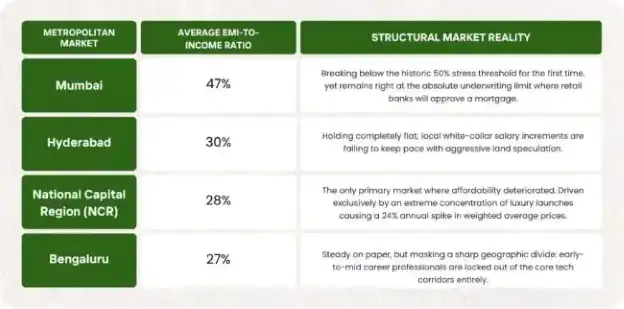
- The 47% Underwriting Wall: How the Knight Frank Affordability Index exposes the absolute limit of local purchasing power.
Segment 1: The Metric That Explains Everything
The most telling indicator of this structural shift sits in the budget segmentation of new residential launches. The historic bedrock of Indian housing-the budget apartments designed for early-career professionals and double-income households-has been systematically starved out of existence.
According to the latest ANAROCK Pan-India Residential Market report, the supply mix has undergone a violent inversion:
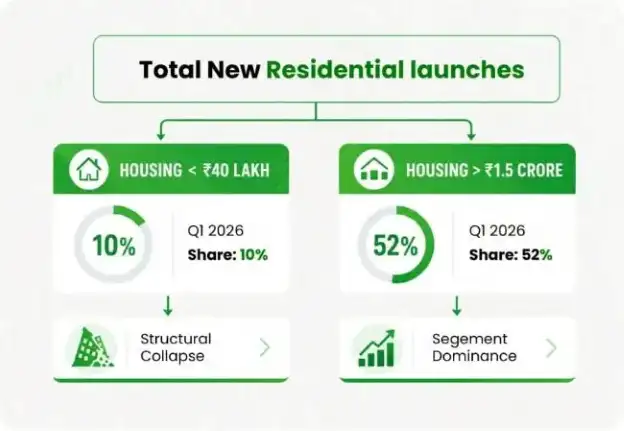
- The Premium Takeover: Homes priced above 1.5 crore-encompassing the high-end, luxury, and ultra-luxury brackets-now command a staggering 52% share of all new launches across India's top seven cities.
- The Affordable Eviction: Conversely, the lower-mid segment (40-80 lakh) has shrivelled to 12%, while the affordable category (below 40 lakh) has hit a historic low of just 10%.
Developers have entirely abandoned volume-driven, affordable housing. In a high-inflation environment, building for the middle class has become an economic dead-end.
Segment 2: NRI Currency Arbitrage
A local salary-earning, rupee-paid income earner is no longer just part of a closed domestic market; they are part of a global asset network. Indian real estate is arguably the most attractive cross-border hedge for global money today.Fueled by a booming global economy and a weak Indian Rupee, the flow of NRI money into physical Indian real estate is at unprecedented levels.When a professional sitting in London, New York or Dubai, looks at a INR 2.5 Cr property, whether in West Hyderabad or Whitefield, he doesn't look at its cost in relation to local household earnings.
Thanks to foreign exchange spreads, it represents a compelling, stable, dollar denominated square footage with a high potential of capital appreciation. This incessant global demand keeps premium properties highly liquid and somewhat resilient; incentivizing builders to not just maintain high prices but constantly push the boundary higher.
Segment 3: The Institutional Credit Architecture
This all-encompassing shift towards premium has its underpinnings in the structure of modern real estate finance. Post-systemic rationalisation of real estate credit, capital for development has undergone significant consolidation. Development finance now mainly revolves around private credit networks, institutional banks, and Alternative Investment Funds (AIFs).
Lenders operating on a defined, risk-adjusted performance model will assess high land costs and material costs, inflated by global supply chains, and come to the clear mathematical conclusion that luxury high-margin property is the most efficient real estate asset class for them to meet institutional debt and lending requirements.
A single premium gated community developed by a Tier-1 corporate brand offers a far more attractive financing proposition than multiple low-margin, delayed, affordable projects in a remote, satellite town. Thus, institutional capital, being pushed up the ladder, flows only to the top, while the sub INR 50 Lakh segment remains structurally undercapitalized. The Metropolitan Affordability Matrix To analyze the strain of housing costs on the common Indian household, we use the Knight Frank Affordability Index; it reflects the percentage of average household income needed to service a typical 20-year mortgage (at an 80% Loan-to-Value ratio).
While lower interest rates from RBI cushioned homeowners, housing valuations are clearly out of sync with income levels in core earning centers:
Conclusion:
A Macro-Economic Success or a Domestic Failure?If we only view real estate as a tool for optimizing capital efficiency and a source of global dollar inflows, the sprint to a USD 1 trillion market size is a masterclass in macro-economic expansion. The focus on luxury is a clear manifestation of a burgeoning affluent upper-middle class.
However, if we view real estate as an enabler of wealth creation at the household level, the current dynamics are fraught with serious challenges. When mid-level software professionals, bank executives, hospital administration, and senior management, are systematically priced out of the core urban hubs, we aren't just observing market expansion; we're witness to an all-encompassing demographic shift. Continue to build your wealth,