Indian Micro-Finance Recovery Analysis
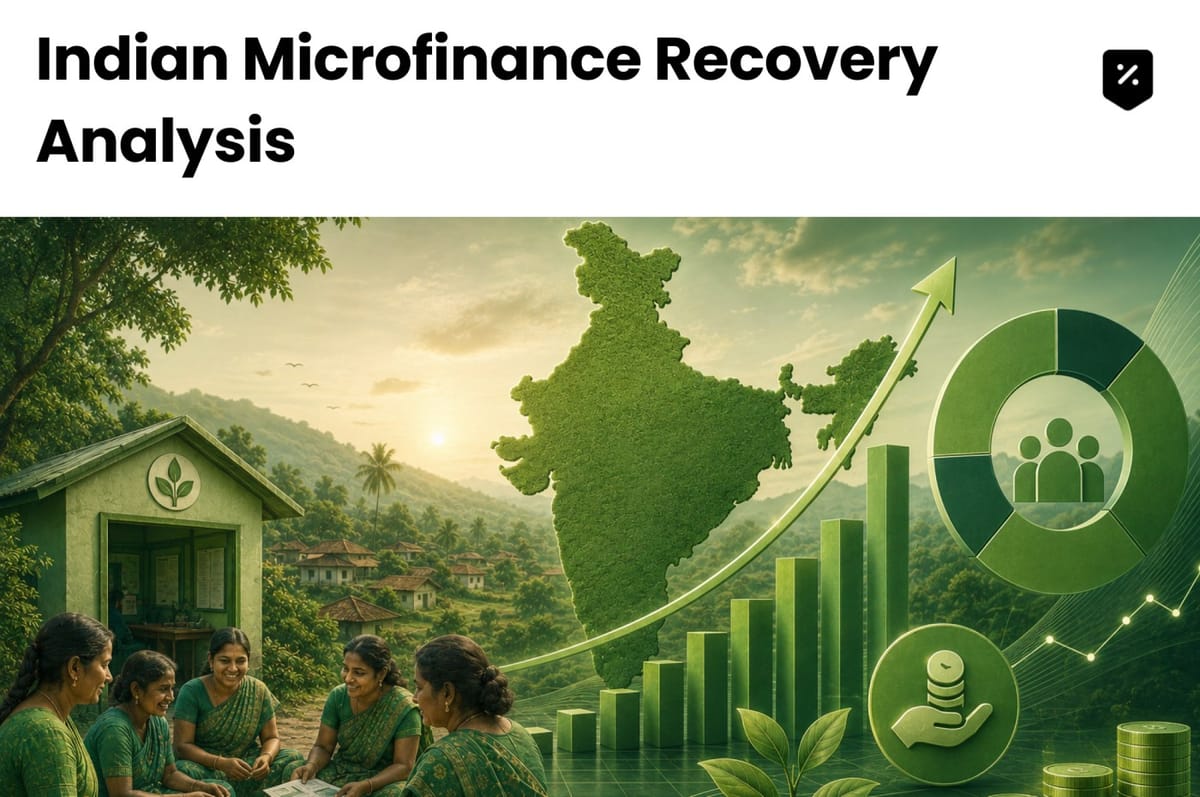
Following seven quarters of consolidation, the Indian micro-finance sector reported a 3.2% QoQ jump in its portfolio to 3.31 lakh crore. A look at asset quality repair and CGSMFI 2.0’s impact. Consumption friction, uneven local inflation, and corporate credit caution have defined macroeconomic conversations surrounding India's rural economy over the past few years.
And through all this, the micro-finance sector, the ultimate transmission conduit for capital to rural and low-income borrowers, spent nearly two years undergoing severe asset quality and structural consolidation post a post-pandemic credit spree.
However, consolidated institutional data available shows that the segment has formally turned a corner. According to the June 2026 edition of the
Micrometer report from the Microfinance Industry Network (MFIN) and the May 2026 SIDBI-Equifax Microfinance Pulse, India's total micro-finance portfolio outstanding, after seven quarters of shrinkage, has turned around and reported a 3.2% QoQ gain to ₹3.31 lakh crore as of the quarter ending March 2026.
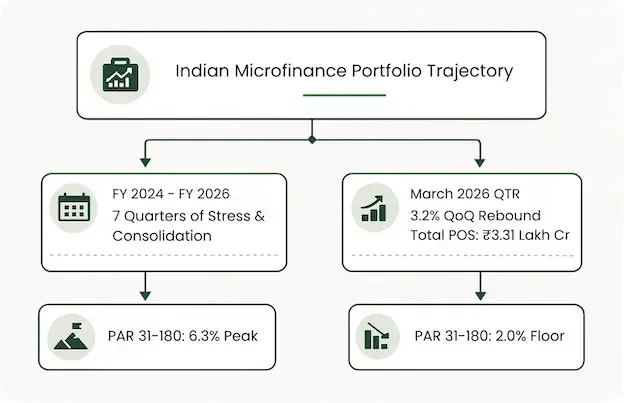
The turnaround signifies a structural regrouping instead of just book expansion and includes disciplined underwriting practices, increased reliance on existing high-vintage, credit-ready customer base and a major state-backed credit facility.
In this formal information report, we examine:
- The Delinquency Compression: Analysing the contraction of Portfolio at Risk (PAR) metrics.
- The Ticket-Size Migration: The operational shift from volume-driven lending to high-value, history-backed accounts.
- The Lender Matrix Shift: How NBFC-MFIs capitalised on the retrenchment of commercial banks.
- The Sovereign Shield: The mechanical impact of the Credit Guarantee Scheme for Micro Finance Institutions (CGSMFI 2.0).
Segment 1: Asset Quality Repair
The primary driver of the multi-quarter contraction for the sector was a spike in asset quality. The Gross Non-Performing Assets (GNPAs) and delinquencies by band had peaked around the midpoint of the 2024-2026 correction cycle. The latest data, however, indicates that the lenders have successfully absorbed these bad loans.
Notably, the early-stage stress metric, PAR 31-180 days (loans overdue 31-180 days), has declined to an exceptionally low level of 2.0% compared to its peak level of 6.3% in the corresponding prior year quarter. Ultra-short-term stress, 1-90 day PAR - came in at 1.4%, a reduction from 4.1%.
While it cannot be understated that some amount of this collapse is statistical due to accounting write-offs over the last four quarters, data on new loan vintages (originated from late 2025 onwards) reflects significantly higher levels of inherent collectibility.
Segment 2: Ticket-Size Transition
Under the hood, micro-finance operations have undergone an immense overhaul. From a focus on acquiring mass customer base from unproven geographies, the focus has now shifted on deepening wallet share with proven and vetted, ETC (Existing to Credit) customer base.
- Disbursement Surge: OMCs as well as specialised micro financiers have recorded a 25.8% QoQ growth in quarterly originations to ₹77,524 crore, the highest single-quarter disbursements in the past seven quarters.
- The Ticket-Size Shift: The share of low-ticket micro-loans (below ₹50,000) continue their decline. Conversely, high-ticket lending ($>=75,000$) jumped to a record 41% of quarterly originations in the latest quarter. The Average Ticket Size (ATS) was ₹61,500, a 18.3% Y-o-Y increase.
This demonstrates an institutional commitment towards credit deepness rather than scale and thus, will lower default risks.
Segment 3: NBFC-MFIs
As Banks withdrew from micro-finance direct Lending operations (under a strict, higher provisioning criteria on un-collateralised consumer loans), a shift took place in the institutional structure.
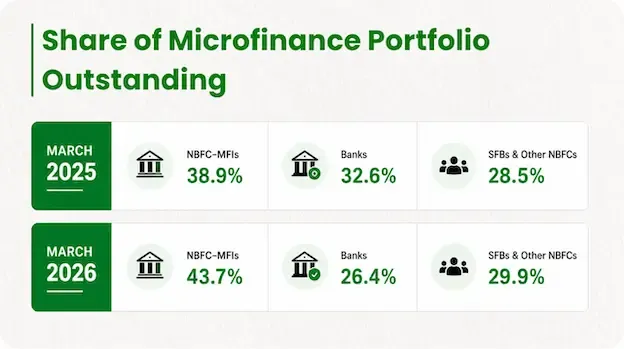
Banks are now running about 8.3% less exposure to direct microfinance loan books (shifting to more profitable structured consumer loan books), which has allowed NBFC-MFIs to gain market share to about 43.7% and cement their position as preferred lending partners for small-ticket lenders across India.
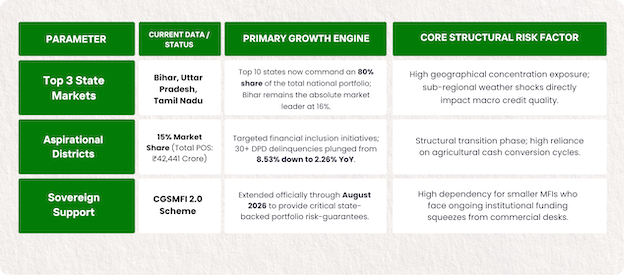
The 2026 Micro-finance Regional and Institutional Scorecard Parameter Current Data/ Status Primary Growth Engine Core Structural Risk Factor.
Segment 4: Sovereign Shield
The fundamental backbone for the current turnaround credit is the Indian government’s recent intervention through the Credit Guarantee Scheme for Micro Finance Institutions (CGSMFI 2.0) when a significant part of India's MFI ecosystem comprising smaller and mid-tier MFIs was finding it tough to raise funds from its lenders (which include all major banks as well as AIFIs - All India Financial Institutions), due to the credit risk from loan books and thereby elevated provisioning.
The CGSMFI 2.0 is essentially a government-backed sovereign-risk-guarantee facility which will lower the risk weight of loans to smaller MFIs for the senior lenders, resulting in easing of borrowing costs and reignited flow of wholesale capital.
The Takeaway
A turnaround to the tune of 3.2% in Q-o-Q for the micro-lending sector has helped to digest its post-covid and post pandemic credit overgrowth.
Listed NBFC-MFIs are leaner, more efficient entities now with significantly cleaned up balance sheets thanks to back-stopped loans from CGSMFI 2.0, lower client acquisitions, and emphasis on loan-book growth that features higher ticket size and historically better collections.
Although macroeconomic conditions like a poor monsoon can pose a near-term threat to performance, the fundamental architecture of credit in India's rural economy has undergone considerable structural reform with asset quality expected to gain more ground, thereby signaling potential profit expansion for SFBs & Listed NBFCs.