India still buying 50% of its oil from Russia?
As India negotiates sensitive trade terms with Washington, maritime data reveals Russian crude quietly captured a record 53.5% of India's total oil imports in June 2026. Inside the Strait of Hormuz crisis and the energy pragmatism driving New Delhi's strategy.
The diplomatic chess board between New Delhi and Washington was supposed to follow a clean, predictable script this month. Negotiators are currently locked in high-stakes talks over a sensitive bilateral trade framework, designed to iron out reciprocal tariffs and smooth over the 25% penalties the US slapped on specific Indian exports last year.
But if you look at the physical flow of global energy assets instead of the official diplomatic readouts, the clean script dissolves into cold macroeconomic pragmatism.
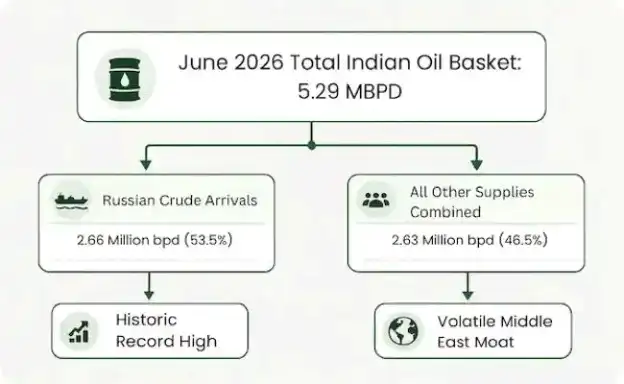
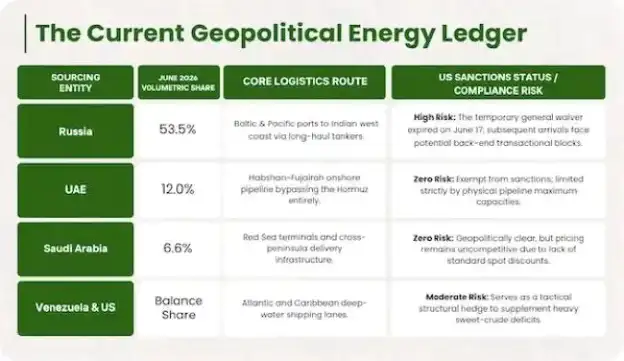
According to real-time vessel-tracking data compiled by maritime intelligence firm Kpler, India’s imports of Russian crude have surged to an unprecedented all-time high of 2.66 million barrels per day (mbpd) for the first three weeks of June 2026. This means Russian barrels didn’t just tick upward—they aggressively captured 53.5% of India's entire crude import basket.
This is occurring at the exact moment the United States' emergency general license, the temporary enforcement reprieve that allowed India to buy Russian oil to stabilize global energy prices, officially expired on June 17, 2026.
India isn't deliberately trying to poke Washington in the eye during a sensitive trade round. Rather, a violent operational crisis in West Asia has forced the state's hand, proving that when the choice comes down to pleasing an ally or preventing a domestic fuel shortage, energy security wins every single time.
In today's edition, we'll analyse:
- The Hormuz Chokepoint Fracture: The maritime shutdown that choked India's traditional Gulf supply lines.
- The Trans-Siberian Bridge: The specific volume numbers tracking Russia's sudden leap from February's lows.
- The Price and Discount Arbitrage: The hard math behind the $4 to $5 per barrel Russian landed discount.
- The Working Capital Realignment: Why the upcoming return of Iranian crude via a 60-day US waiver alters the financial calculus for local refiners.
Segment 1: The Strategic Catalyst
To understand why Indian public sector and private refiners suddenly abandoned their diplomatic caution, you have to look at the shipping channels of West Asia.
Historically, Gulf producers supply between 60% and 70% of India’s crude needs. But the escalation of the regional conflict involving Iran completely jammed the Strait of Hormuz, a critical chokepoint handling a quarter of global oil consumption.
The physical closure of the Strait systematically cut off India's core supply nodes:
- The Iraq Evacuation: Iraq, which relies almost exclusively on the Hormuz shipping lane to move its oil out of basra terminals, saw its export capacity to Asia pulverized. Indian refiners were forced to drastically slash their Iraqi allocations.
- The Pipeline Moat: Only Saudi Arabia and the UAE managed to maintain stable, muted export streams to India. The UAE utilized ADNOC’s Habshan-Fujairah pipeline, which physically cuts across the country to load tankers completely outside the Persian Gulf, supplying a modest 636,000 bpd to India this month. Saudi Arabia fell back to an estimated 349,000 bpd—down over 50% from its pre-conflict average of 832,000 bpd.
Faced with a massive structural deficit from traditional suppliers, Indian refiners turned to the only liquid ocean-borne market insulated from the West Asian conflict: Russia's seaborne Urals and ESPO networks.
Segment 2: February Sanctions to June Records
The sheer velocity of this pivot exposes how fluid modern commodity routing has become. Just four months ago, in February, US sanctions pressure against Russian state shippers like Rosneft and Lukoil successfully forced Indian purchases down to a multi-year low of just 1.04 mbpd.
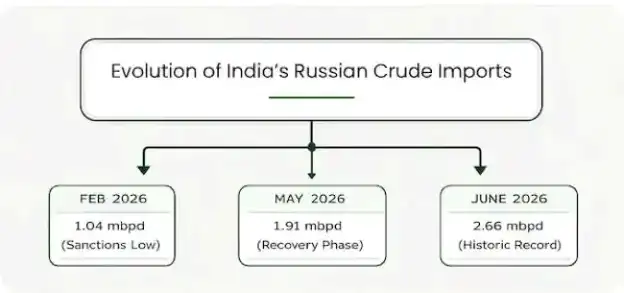
The combination of the temporary US price-cap reprieve and the sudden closure of the Gulf completely reversed that trend line. The current 2.66 mbpd print represents a blistering 40% month-on-month expansion over May's arrivals, completely obliterating India’s previous lifetime import record of 2.2 mbpd set back in May 2023.
Segment 3: Landed Discounts vs. Freight Premiums
While the massive headline volumes point to geopolitical maneuvering, the underlying decisions are made by enterprise accountants at Indian Oil Corporation (IOC), Bharat Petroleum (BPCL), and Reliance. The decision to absorb over 2.6 million barrels a day comes down to a clear corporate finance calculation:
- The Sticker Discount: With global Brent crude hovering near $77.5 to $80.50 per barrel, Russian state producers are offering barrels at a clean $4 to $5 discount relative to the international benchmark.
- The Net Premium Shift: This discount is noticeably thinner than the $10-$30 spreads seen during the initial 2022-2023 cycle, and it is partially eaten up by elevated logistical costs, with specialised shipping insurance and long-haul Baltic-to-India freight routing averaging $3 to $7 per barrel.
However, when compared to the extreme panic premiums of $13 to $15 per barrel that Middle Eastern suppliers were demanding at the height of the Hormuz blockade, Russian crude remains the most capital-efficient raw material available on the global map.
The Current Geopolitical Energy Ledger
The Upcoming Realignment
The immediate question for India's trade negotiators is how long they can maintain this delicate balancing act before Washington transforms its frustration into active export penalties.
The exit door for New Delhi is already being engineered by the US itself. In a bid to urgently cool down global energy inflation, the US has authorized a temporary 60-day general license allowing the production, delivery, and sale of Iranian crude while high-level diplomatic talks advance.
This upcoming realignment alters the working capital mechanics for domestic refiners. Iranian crude historically lands in India with a highly favorable 60-to-90 day credit window (compared to the strict 30-day payment cycles demanded by other producers), significantly lowering the short-term working capital requirements for state refiners. Furthermore, the short geographical proximity between Iran’s Kharg Island and India’s ports dramatically slashes freight and insurance overheads.
The Bottom Line
India's record-breaking Russian oil run this month was not a structural declaration of geopolitical alignment; it was an act of raw emergency management.
When traditional Middle Eastern shipping lanes closed down, the Indian state did exactly what any sovereign nation must do: it bought the cheapest, most available fuel on the water to keep its domestic industrial core from grinding to a halt.
As the Strait of Hormuz slowly prepares to reopen and Iranian barrels return to the market with attractive credit terms, expect Indian refiners to naturally pare back their record-high Russian exposure over the next 90 days. New Delhi has successfully proven its core foreign policy thesis: in a fragmented global economy, the ultimate asset isn't total allegiance to a single superpower—it is the structural flexibility to pivot to whichever pipeline keeps the lights on.