Budget Required To Invest In Mumbai Real Estate? (2026 Area-Wise Price Guide)
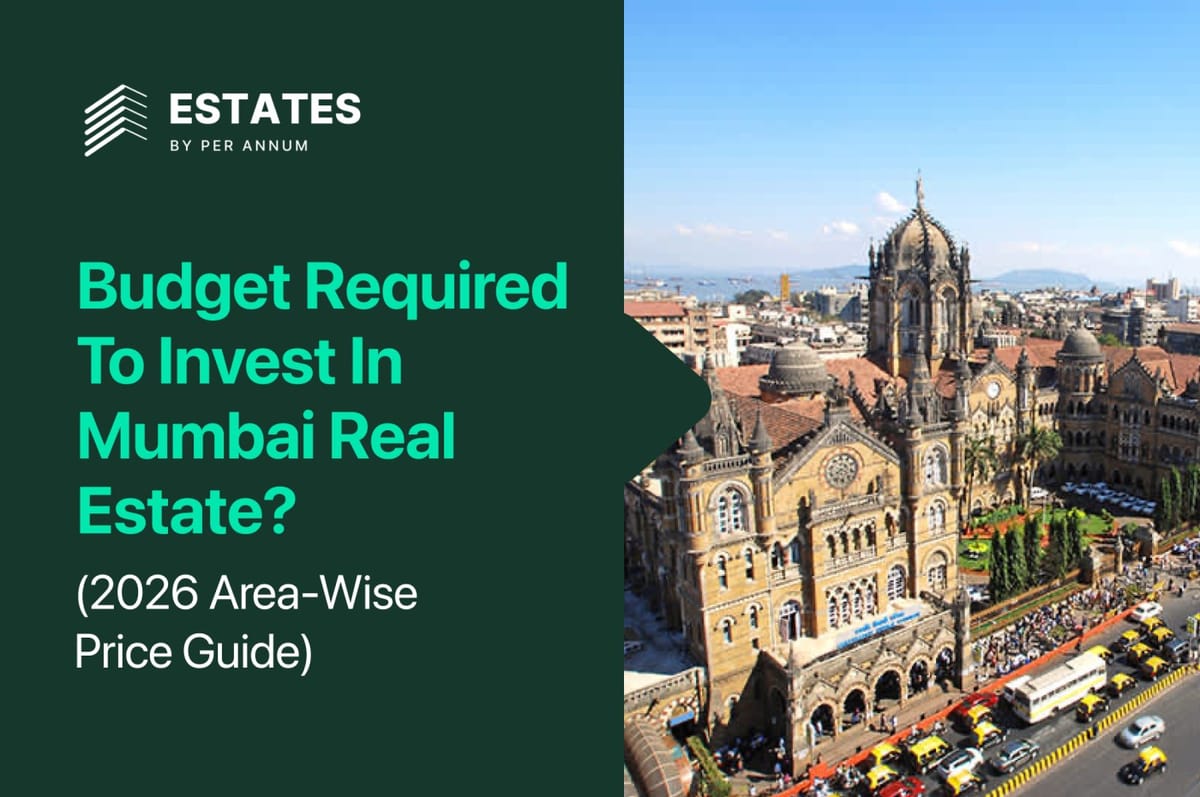

“How much budget is required to buy a property in Mumbai?” - this is undoubtedly the most daunting real estate question as Mumbai isn’t a monolithic property market; rather, it’s a complex web of multiple micro-markets perched one atop another. Move past a single flyover, and you’ll encounter asking rates jumping up to 15,000 per square foot! A budget sufficient for a 1 BHK in Bandra might allow you to purchase a sprawling 3 BHK with a landscaped garden in Panvel.
To provide a clear roadmap, we’ve segmented Mumbai and its sprawling Metropolitan Region (MMR) into three practical budget categories - encompassing 10 high-end, 10 mid-range, and 10 affordable residential areas. Each category details the projected 2026 price per square foot, alongside the actual all-inclusive budget you’ll need to plan, going beyond the listed price.
A note on our scope: In common parlance, “Mumbai real estate” covers not only the island city and its western and eastern suburbs but also the wider MMR, including Thane, Navi Mumbai, Mira-Bhayandar, and Vasai-Virar. This comprehensive approach offers an accurate financial outlook, regardless of whether your dream home is in South Mumbai or at the far end of the Central Line.
How Property Rates are Quoted in Mumbai
Before we dive into the numbers, let’s establish how property rates are typically quoted in Mumbai. They are most often expressed as the price per square foot (sq. Ft.) of either the built-up area or the carpet area, with variations of 20-40% possible within the same locality, influenced by factors like building age, floor level, view, and available amenities. Treat all price points mentioned below as midpoints; always verify the current rate for the specific property and floor you are considering.
Tier 1: Top 10 Most Expensive Areas in Mumbai (2026)
These are Mumbai's elite residential locales, primarily situated in South Mumbai and along the western coast, where factors like exclusivity, historical significance, and proximity to the sea drive prices to India’s highest echelons.
Budget: To secure a basic 2 BHK in these premier localities, anticipate a minimum budget of ₹5-6 crore, with high-demand areas like Malabar Hill and Altamount Road requiring at least ₹8-9 crore and extending beyond ₹40-50 crore for large, sea-facing residences and penthouses. These neighbourhoods typically yield the lowest rental returns in the city (approximately 2-3%), with appreciation serving as the primary investment return driver.
Tier 2: 10 Moderately Priced Areas in Mumbai (2026)
This category encompasses the well-established western, central, and eastern suburbs, as well as the more mature parts of Navi Mumbai and Thane. These areas offer a desirable blend of accessibility, social infrastructure, and competitive pricing, circumventing the long commutes associated with Mumbai's outer periphery.
Budget: A comfortable 2 BHK that’s ready to move in, across this tier, typically falls within the range of ₹1 crore to ₹2.5 crore. Areas like Powai and Andheri West command higher prices due to their proximity to the Bandra-Kurla Complex and key business hubs. Kharghar and the outer sectors of Navi Mumbai offer more budget-friendly entry points. These localities offer better rental yields than South Mumbai, usually ranging between 3-5%, making them attractive for both end-users and buy-to-let investors.
Tier 3: 10 Wallet-Friendly Locations in the Mumbai Metropolitan Region (MMR)
This segment of the MMR is where your chance of getting into Mumbai-region property without breaking the bank still exists. Think along the Vasai-Virar and Central Line belts, as well as the fringes of Navi Mumbai, which are dominated by mass-housing developments and integrated townships.
Budget: Within this tier, you could snag a 1 BHK for as little as 15-30 lakh, particularly in areas further out or through government-backed affordable housing initiatives. For a practical 2 BHK, the realistic range falls between 30 lakh and 1 crore.
The primary compromise?
Your commute time.
Virar, for instance, is a 65 km journey from South Mumbai, and the train ride to CSMT can take 75-90 minutes. However, planned infrastructure improvements like the Vasai-Boisar rail extension, metro expansion, and the Mumbai-Ahmedabad bullet train with a station in Virar are expected to shorten this gap in the coming years. This tier also features many large integrated townships (think Lodha Palava in Dombivli, Godrej Garden City in Panvel), offering a package of schools, shops, and healthcare with your home.
What Will Your Actual Budget Be?
The price per square foot is just the starting point. When calculating your true budget, don't forget to factor in:
- Stamp Duty: Generally around 5-6% of the property value in Maharashtra. This can vary slightly by municipal corporation and buyer category, with women often receiving a concession.
- Registration Fee: A flat 1% of the property value, with a cap of 30,000 for higher-value properties.
- GST: For under-construction properties without input tax credits, it’s 5%; for ready-to-move-in homes with a completion certificate, it's 0%.
- Brokerage: If you're using an agent, expect 1-2% of the transaction amount.
Home Loan Fees: Look for 0.5-1% for loan processing, plus legal and technical evaluation charges. - Society Deposits: A substantial upfront maintenance deposit is common for gated communities and townships.
- Interior and Fit-Out Costs: For shell-like under-construction apartments, this can add an additional 150-400 per sq. Ft., or more, depending on your desired finishes.
As a rough guideline, add an extra 8-12% to the listed property price to cover statutory dues and transaction expenses. If you're buying an under-construction unit and plan extensive interior work upon possession, add even more.
Budgeting Based on Your Investment Goals
- Pure capital appreciation, long horizon (7–10+ years): South Mumbai and Bandra remain the most resilient long-term holds, but appreciation there has been steadier (not necessarily faster) than emerging corridors — expect 6–9% average annual growth per recent market data.
- Rental yield focus: Mid-tier suburbs (Powai, Andheri, Thane, Navi Mumbai) generally deliver the best balance of yield (3–5%) and liquidity, since rental demand is driven by a large working professional base.
- Maximum appreciation potential, higher risk tolerance: Areas riding fresh infrastructure, Panvel and Ulwe (Navi Mumbai International Airport, MTHL), Thane (metro and IT-park growth), have shown the sharpest recent price movement, though every such swing should be read directionally rather than treated as a guaranteed repeat.
- Tightest budget, willing to trade commute for space: Vasai-Virar and the Ambernath-Badlapur-Taloja belt offer the most space per rupee in the MMR, especially inside integrated township projects.
Frequently Asked Questions
- What's the entry-level price for a Mumbai flat in 2026?
In affordable areas like Ambernath, Badlapur, and far-out Vasai-Virar, you might find a 1 BHK starting around 15-25 lakh; especially in MHADA or other affordable housing projects. For a standard 2 BHK in any part of the MMR, realistically budget at least 30-40 lakh.
- What's the average price of a 2 BHK in Mumbai?
The average 2 BHK price across Mumbai can be cited around 2 crore, but this is a significant generalization. It ranges from under 50 lakh in the outer MMR to well over 8 crore in prime South Mumbai and Bandra.
- Which Mumbai areas are experiencing the fastest price growth currently?
Recent data suggests that areas benefiting from new infrastructure – Panvel and Ulwe (thanks to the upcoming international airport and MTHL) and Thane (with its expanding metro network and IT hubs) – are showing the most aggressive price appreciation. Pockets like Naigaon have also seen notable percentage gains from a lower base.
- Should I invest in South Mumbai or the suburbs?
It entirely depends on your objectives. South Mumbai offers prestige, inherent value due to scarcity, and stable long-term appreciation, but lower rental yields. The suburbs and Navi Mumbai often provide a better rental yield and have shown stronger recent price momentum at a much lower entry point.