Are You Ready to Bypass India’s Overseas Investing Bottlenecks?
India's latest reform on curbing the cost of retail investor capital and investing abroad, on public exchanges outside its shores, the biggest shift in more than a year since it was initially formed.
Regulator of India's financial zone, International Financial Services Centres Authority or IFSCA, has issued final permission to India's four largest retail brokers to list the same, Groww, Zerodha, Angel One, and Upstox to access offshore investments directly, including the United States equities, without hurdles.
All four entities anticipate a 60-to-90-day timeline for the official roll-out which will permit their engineers time to integrate cross-border ledgers, pass compulsory security tests of clearing houses, and activate the trading and live operations systems.
This is nothing short of establishing an institutionalised direct channel for 2.84 crore active traders to hedge exposure by way of diversifying assets away from a single market.
Here's the deep dive of what the Indian government is ushering in:
- The size of the four public broker's domestic fan following.
- Differences between GAP Framework, the Broker-Dealer Structure.
- Back-end of international trading, clearing.
- Flow of funds using India's LRS through gift city.
Segment 1: Scale of Indian Retail Trading Public To Gain International Exposure
While a small set of specialised brokers already provided niche pathways to the globe, the entry of top local retail broker platforms can simultaneously boost the flow of international capital almost overnight.
The number of active users among these platforms highlights how significant this regulatory clearance becomes as an accelerator to the Indian retail investor community:
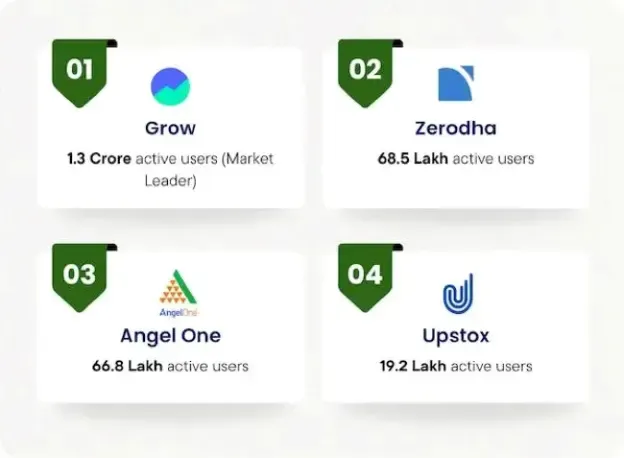
The global equity investment feature within primary trading dashboards reduces the significant, and sometimes crippling cost and complexity of an existing individual investor setting up an account with an external broker.
Segment 2: GAP vs Broker-Dealer
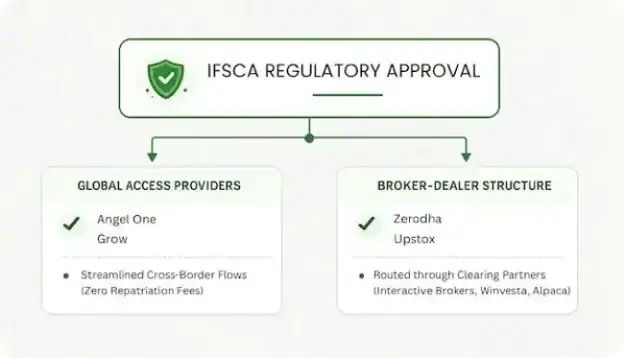
The IFSCA didn't issue a single regulatory charter but bifurcated them. It’s split the licenses into two, the functioning and treatment of trades will vary within these architectures fundamentally.
Global Access Provider (GAP) Structure:
Groww and Angel One will operate under a unique regulatory framework approved by the IFSCA that aims to streamline cross-border retail investments and put to bed complexities that previously hampered Indian Retail Traders.
Key Benefit: GAP offers an immediate cost saving to retail investors as the conventional outflow payment fees for repatriating capital from U.S. Dollars to Indian rupees upon sale of U.S. Shares no longer apply.
Functionality: It permits the broker to be recognized and operate as a direct, compliant Indian doorway to global stock exchanges.
Broker-Dealer Structure:
Zerodha and Upstox, which are traditionally clearing firms for trades of Indian stocks, will utilize this model for offshore transactions.
The Core Partners: Technical integrations are being executed alongside dominant global clearing firms, specifically ViewTrade International (which holds its own active GAP clearance), Interactive Brokers, and Alpaca Securities.
Functionality: Rather than setting up a wholly indigenous international market entry route, this model entails routing of customer trades to major international clearing houses, which include partnerships with, but are not restricted to,
Segment 3: Mechanics of Fund Transfer and compliance rules
The transfer of Indian Rupee from the consumer to any international investment is processed as per a stringent rule set under Reserve Bank of India, the regulator.
- LRS Framework Compliance: Every transaction executed abroad must be aligned with the RBI’s LRS which dictates an annual outward investment limit of $250,000 for individuals.
- Transaction Framework: Funds move from an Indian account holder to the broker’s clearing account in GIFT City, after which currency conversions take place to Dollars, and the funds are kept at the IFSC. In order to provide seamless transaction experience to the consumers,IFSCA amended its rules to enable broking firms to choose routing of funds through IBUs, or authorized payment service providers.
- Exchange rate Risk: Every overseas trade by a retail investor will carry an exchange rate risk because both legs of the transaction - IndianRupee to Dollars, and Dollars back to IndianRupee - will always be prone to fluctuations in international markets.
Conclusion
The growing demand among Indians for foreign equities isn’t just about diversification any more - it is primarily about capitalizing on global technology megatrends like semiconductors, cloud services and advanced aerospace solutions which do not have comparable listed equities in the local Indian market.
By having an India-regulated gateway in GIFT City offering low-cost international investment exposure, the IFSCA has made it considerably more cost-effective and convenient for retail savers to participate. The upcoming window, over the next couple of months, promises to transform the way India’s disciplined wealth managers access foreign tech exposure from a luxury to a widespread asset class.